
Wenwan Walnuts: The Chinese Art of Pairing, Rolling, and Patina
Last updated: October 2026
In September 2026, guests invited to Dior's Spring/Summer 2027 show in Paris received something unusual with their invitation: not a printed card, but a pair of walnuts. Not the edible kind. These were wenwan walnuts — large, thick-shelled, densely ridged nuts kept as objects of study and handled daily in the palm.
The walnuts were not a stunt that stopped at the invitation. A silver minaudière shaped like a single walnut appeared on the runway, and the show notes were typeset in the silhouette of one. For an audience outside China, it was the first close look at an object that has been part of Chinese daily life for centuries — and that most English-language readers have never had a word for.
This guide explains what wenwan walnuts are, why they are kept in pairs, how the glossy finish develops, and what a beginner should know before buying a first pair.
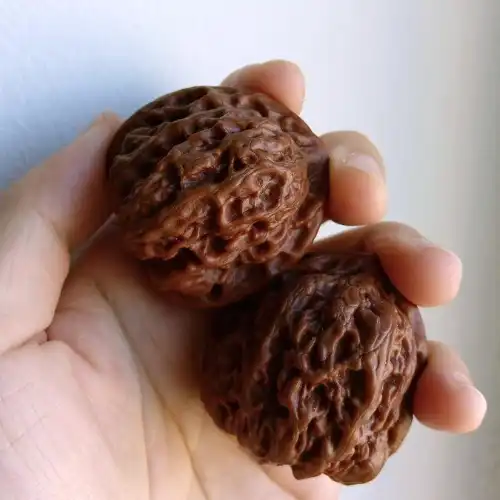
A matched pair of wenwan walnuts. The reddish sheen is patina — years of handling, not a finish applied to the shell.
What Are Wenwan Walnuts?
Wenwan (wénwán) translates roughly as "cultural plaything" — an object kept for handling, study, and enjoyment rather than for any single practical use. Wenwan hétáo — wenwan walnuts — are a specific kind: not food, but walnuts selected for thick shells and intricate ridge patterns.
They come from named cultivars, mainly of Juglans hopeiensis, a walnut species native to northern China. What makes a wenwan walnut is not the kernel, which is small and not the point, but the shell: its density, its ridges, the way light sits on a surface that has been polished by years of contact with a hand.
They are sold in pairs. They are sometimes carved. And they are, above all, meant to be held.
Why People Roll Them
The handling is called pán — rolling a pair gently inside one palm, moving them against each other so that every part of both shells is touched. It is a quiet, repetitive motion, closer to turning a ring on a finger than to any kind of exercise.
The practice sits in the same family of objects as Baoding balls, the metal exercise balls named after the city of Baoding in Hebei, which have been rotated in the hand since the Ming dynasty. Both rely on the same idea: small objects moved in the palm, used to occupy the hands and settle the attention. In Chinese folk practice, that motion is said to help hand dexterity and to quiet a restless mind.
The Pair Matters More Than the Nut
A single handsome walnut is a curiosity. A matched pair is the point.
Wenwan walnuts are judged in twos, and the standard is closeness: two shells that echo each other in size, shape, ridge structure, and colour, so that they read as a set rather than as two good objects that happen to sit side by side. Perfect symmetry is genuinely rare — shells grow, they are not made — so what buyers look for is a matched pair, not an identical one. Collectors describe the search in terms that are close to matchmaking, and in China it is not unusual for a collector holding one excellent walnut to advertise for its counterpart.
Beyond pairing, three things are weighed:
- Size. Larger is generally preferred. Most pairs fall between 3 and 4 cm across; shells over 5 cm are uncommon and sought after. In recent years small-shelled varieties from wild trees have found their own following.
- Shape and ridges. Deep, well-defined ridges and a rounded, balanced profile are prized. A shell that stands up evenly, without tipping, is a shell a seller can present well.
- Colour and surface. Two shells from the same tree can differ in tone. The aim is a pair that patinates evenly, so that any difference between them narrows with time rather than widening.
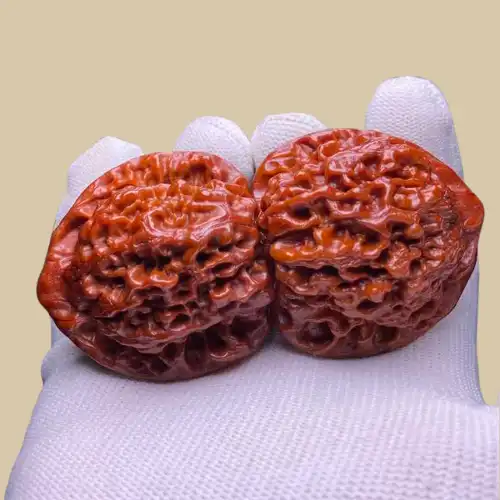
A matched pair held together. Pairing is judged on closeness — size, shape, ridge structure, and evenness of tone.
How Patina Forms
The glossy red finish that defines a well-kept pair is called bāojiāng. It is not a coating and not a lacquer. It is the result of friction — of hands, over years — together with sweat and the skin's natural oil, working on the shell's surface until it develops a warm, deep sheen.
That is the whole mechanism, and it is worth saying plainly because the finish is easy to romanticise. Nothing is absorbed mystically and nothing is charged. A pair darkens and glosses because it has been handled, consistently, for a long time.
This also means patina cannot be faked convincingly. A pair that has been oiled overnight to look older will read as oily. Time is the only ingredient that cannot be substituted, which is exactly why the look carries weight among collectors.
Because the finish comes from handling, the age of a pair is measured less in years owned than in hours held. Two pairs of the same age may look entirely different depending on how often they were rolled — and that gap is visible to anyone who knows the object.
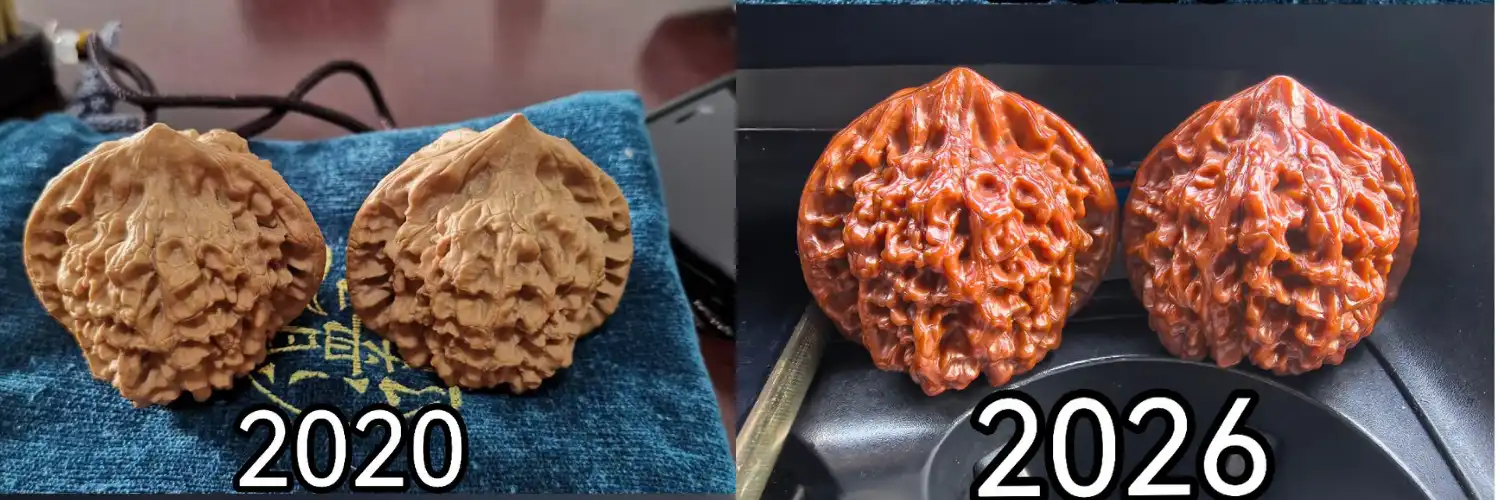
The same pair, six years apart. Left, 2020 — dry, pale, untreated. Right, 2026 — patina from handling alone.
The Species and the Trade
Most wenwan walnuts come from Juglans hopeiensis cultivars, selected over generations for shell thickness and ridge definition. Historically, two other types dominated — qiúzi walnuts and iron walnuts — and both are comparatively unfashionable today, though they appear in older collections.
The market has its own vocabulary for how the nuts are produced. Grafting, which improves yield and shell quality, was initially controversial among purists and has since become broadly accepted; the objection was never botanical so much as a question of what "traditional" should mean. Some growers shape the nut deliberately while it is still growing on the tree.
There is also a tradition of buying blind. In autumn, street vendors sell pairs still enclosed in their green husks, and buyers choose without knowing what the shell underneath looks like — a gamble known as dǔ qīngpí — literally, "betting on the green skin." It is a small market ritual, and it exists precisely because the thing being judged is hidden until the moment of purchase.
A Short, Honest History
Walnuts have carried cultural weight in China since the Han dynasty, though they were not widely grown or eaten until the Tang. The art of carving fruit pits flourished from the mid-Ming into the early Qing, and finely carved walnuts were treasured by officials and nobles — designs ran to flower baskets, playing children, and arhats.
The earliest physical evidence of walnuts kept specifically for hand massage comes from the Qing court: more than ten well-worn pairs in what is now the Palace Museum in Beijing, some carved, some stored in cases decorated with symbols of longevity, some labelled as gifts from nobles. One pair was kept with its own desk stand; another in a waist bag. Tellingly, those court pairs were mostly qiúzi and iron walnuts — the very types that are least popular now. Taste moves.
The modern revival came with economic reform and a renewed interest in traditional culture, spreading outward from Beijing. Then came the bubble. Around 2010, with new restrictions on Beijing's property market, wealthy buyers moved money into alternative goods — tea, garlic, and wenwan walnuts among them. At the peak, an exceptional pair could change hands for 300,000 to 400,000 yuan. Farmers grafted aggressively to meet demand, supply flooded in, and the market began to soften from 2014 before crashing in 2015.
By 2023, high-quality pairs were trading around 20,000 to 30,000 yuan, with most of the value attributed to how long they had been handled rather than to scarcity. That is the more honest way to read the object: the walnut itself is not rare. The patina is.
How to Start
For a first pair, the useful advice is to begin small in every sense — modest shells, modest price — because the point of a first pair is to learn how the object changes in your hand, not to own a good one.
Handle them clean and dry. Roll gently rather than working them hard; the finish comes from time, not pressure. Keep them away from water, from oiling, and from anything designed to speed up the process. Rotate evenly so both shells wear at the same rate, which keeps a matched pair matched. And expect the first months to look like nothing is happening — patina is slow, and it is supposed to be.
What Wenwan Walnuts Are Not
- They are not a medical treatment. Rolling walnuts in the hand is a traditional practice and a personal ritual. It is not a therapy, and it is not offered as one.
- They are not an investment. The 2010–2015 market is a useful cautionary tale, not a template. Pairs are kept for enjoyment; treating them as assets is how the bubble happened.
- They are not one specific species. Juglans hopeiensis dominates today, but the category has shifted before and can shift again.
- They are not fakeable. A glossy red finish cannot be manufactured quickly. If a pair looks decades old and is inexpensive, it was oiled, not handled.
Questions People Ask
What are wenwan walnuts?
Wenwan walnuts are Chinese walnuts — mainly of Juglans hopeiensis — selected for thick shells and detailed ridges, then kept in matched pairs and rolled in the hand. They are objects of collecting and daily ritual rather than food.
Why are they kept in pairs?
Because the practice is about two shells moving against each other, and because collectors value closeness: a pair matched in size, shape, ridges, and colour. Matched pairs are genuinely difficult to find, since the shells are grown rather than made.
What is patina and how does it form?
Patina, or bāojiāng, is the glossy reddish finish that develops on a handled shell. It forms from friction, sweat, and the skin's oil acting on the surface over years. It cannot be produced quickly, which is why it carries value.
How long does it take?
It depends entirely on handling. There is no fixed schedule; the finish is a record of hours, and two pairs of the same age can look completely different.
Is rolling walnuts good for your hands?
It is a traditional practice associated with hand dexterity and quiet attention, and it sits in the same family as Baoding balls. It is not a medical treatment and no health outcome should be expected.
What is dǔ qīngpí?
It is an autumn market tradition: buying pairs of walnuts still inside their green husks from street vendors, without knowing the shape or colour of the shell inside.
Looking at Other Wenwan Objects
Wenwan walnuts belong to a wider category of Chinese objects valued for how they change with handling rather than for what they are at the start. The walnut's patina deepens with the hand; other materials in the same family change differently — some colour, some take on a sheen, some shift in tone with nothing more than the oils of a palm.
One of the most familiar in this group is star and moon bodhi, whose beads darken and open up over months of wear. It is a different material with a different rhythm, and we cover it in a separate guide.