
New to Dzi Beads? Here's What to Avoid Before You Buy Your First One
If you're a beginner looking to buy your first Dzi bead, the fastest way to protect yourself isn't knowing what to look for — it's knowing what to avoid. This guide walks through six types of Dzi beads a first-time buyer should stay away from, and why.
1. Don't Buy "Ancient" Dzi Beads
If this is your first Dzi bead purchase, do not buy one sold as an "ancient" or antique Dzi bead. You will almost certainly be scammed.
Dzi beads genuinely do have a history stretching back over a thousand years. But after China's Tang Dynasty, the traditional craftsmanship used to make them was lost. That means from the end of the Tang Dynasty all the way until the 1980s, no Dzi beads were being made using the original ancient techniques.
Dzi beads have been deeply treasured by Tibetan people since ancient times. Beads passed down through generations are considered part of a family's spiritual inheritance — not something to be sold for money. So if a bead is genuinely ancient, it's effectively a thousand-year-old antique, and antiques like that essentially never circulate on the open market.
Do authentic ancient Dzi beads exist? Yes. But if you're a beginner spending money hoping to buy one, you're almost certainly going to get burned. Genuine ancient Dzi beads are typically priced anywhere from roughly 150,000 to tens of millions of RMB (tens of thousands to several million USD). And even if you're willing to pay that much, there's still a very high chance what you're buying is fake.
2. Don't Buy "Fake" Dzi Beads
Here's something important to understand: Dzi beads aren't really divided into "real" versus "fake" — they're divided into "new" versus "old."
Old (ancient) Dzi beads are collector's items that almost never circulate in the market, as explained above. New Dzi beads refer to beads made after the 1980s, when a number of workshops in Taiwan successfully recreated the ancient bead-making process. These beads are made from natural agate, using the same traditional techniques: whitening treatment, natural mineral dyes, an etching process to create the patterns, hand-drawn linework, and a final aging/weathering treatment on the surface. These beads are genuinely well-regarded among Tibetan communities and are primarily sold into the Tibetan region.
What you want to avoid are modern beads — sometimes falsely marketed to you as "old" Dzi beads — that are NOT made using this traditional craftsmanship. Those are the ones to skip.
3. Don't Buy Chemically-Treated Dzi Beads
To maximize profit, some factories today use industrial chemical dyes to color their beads instead of natural mineral pigments.
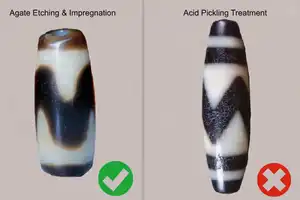
Even more concerning for your health: avoid acid-washed Dzi beads. Acid-washing is an artificial aging technique typically used on beads made from lower-quality raw material that never went through the proper whitening process in the first place. Here's how it works: an acid-resistant coating is painted onto the agate bead to form the pattern, and the bead is then submerged in strong acid — nitric acid, hydrochloric acid, aqua regia, and similar compounds — to corrode the surface. This is meant to simulate the look of decades of natural weathering or burial, making the bead appear more "ancient" and more valuable.
Acid-etched agate has a distinctive "corroded" look to it: the surface has a dull, lifeless shine, lacking the natural oily luster of real agate. Under magnification, it looks uniformly fuzzy and matte, almost like frosted glass.
4. Don't Buy Colorful Dzi Beads
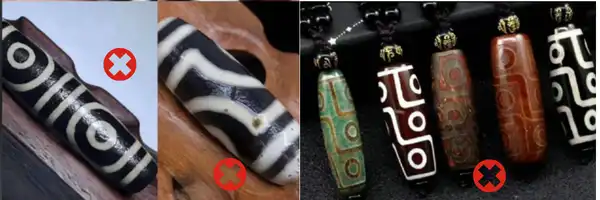
Authentic old Dzi beads only ever came in black, white, and brown. Bright colors never appeared in Dzi beads throughout their thousand-year history — meaning there's no traditional craftsmanship behind colorful pieces.
Colorful Dzi beads are a modern invention, and they're almost always acid-washed beads as well. They also tend to be sold at very low prices.
5. Don't Buy Dzi Beads With Unusual, Made-Up Patterns
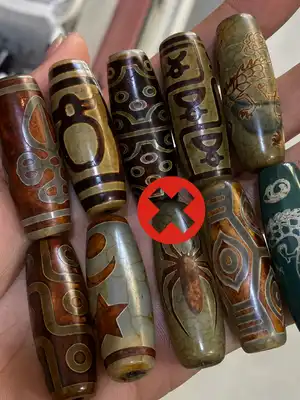
Dzi beads made with authentic traditional craftsmanship almost always feature patterns with documented historical significance — each one carrying its own inherited spiritual meaning.
If a bead's pattern doesn't have that historical grounding, it's simply a piece of decorative craft jewelry — which is completely fine to buy if you like how it looks, but you should treat it (and price it) as ordinary jewelry, not as an authentic Dzi bead.
6. Treat Dzi Authentication Certificates Carefully
Certificates can be useful for identifying material, such as whether a bead is agate. But a material certificate is not the same as proof that a Dzi bead is truly ancient.
No authoritative institution is currently able to issue a true ancient Dzi bead authentication certificate.
This means beginners should be careful with certificates that appear to prove age, spiritual power, temple origin, or ancient status. A certificate may tell you something about the stone, but it cannot replace experience, provenance, and careful judgment.
The bottom line: as a first-time buyer, the safest and most rewarding path is to look for well-made new Dzi beads — crafted using the genuine traditional process, in natural black/white/brown tones, with historically meaningful patterns, sold honestly as new pieces rather than passed off as ancient ones. That's where real craftsmanship, real symbolism, and real value actually live.
What Should a Beginner Choose Instead?
For your first Dzi bead, choose honesty over drama.
- Choose a contemporary Tibetan-style Dzi bead sold clearly as contemporary craft.
- Look for agate body, clear pattern language, and a surface that feels intentional.
- Choose black, brown, ivory, cream, or warm agate tones if you want a more traditional visual style.
- Start with a pattern whose meaning you understand and personally connect with.
- Read the product description carefully: material, process, cord, size, and whether the piece shown is the exact piece you receive.
A Dzi bead does not need to be ancient to be meaningful. A well-made bead, chosen with care, can still serve as a powerful symbolic reminder in daily life.
How Kris Nature Selects Dzi Beads
Kris Nature Dzi beads are personally selected from trusted Tibetan-style artisan studios known for serving the Tibetan market. These are beads appreciated for their pattern clarity, surface texture, agate body, hand-feel, and traditional visual language.
We choose each piece one by one, not only for how it looks, but for the presence it carries when worn.
In Tibetan culture, Dzi beads have long been cherished as symbols of protection, blessing, steadiness, and spiritual alignment. At Kris Nature, we honor that meaning while keeping every material description honest and clear.
This is jewelry rooted in real craft, cultural memory, and quiet daily intention.
Frequently Asked Questions
Are modern Dzi beads fake?
No. A modern Dzi bead is not automatically fake. The key question is whether it is described honestly. A contemporary Tibetan-style Dzi bead can be meaningful craft when the seller clearly explains that it is modern, not ancient.
Should a beginner buy an ancient Dzi bead?
Usually, no. Ancient Dzi beads are difficult to judge and can be extremely expensive. Beginners are safer starting with honestly described contemporary Tibetan-style Dzi beads.
What is the safest first Dzi bead to choose?
Choose a clear traditional-style pattern, an agate body, natural or earthy tones, and a seller who explains the material and process clearly. The bead should feel wearable, understandable, and personally meaningful to you.
Can a certificate prove a Dzi bead is ancient?
A certificate may help identify the material, such as agate, but it should not be treated as full proof that a Dzi bead is truly ancient. Age, provenance, and cultural value are much harder to certify.
Does a Dzi bead guarantee protection or luck?
In Tibetan culture, Dzi beads are cherished as symbols of protection, blessing, and spiritual steadiness. At Kris Nature, we offer them as meaningful jewelry and cultural ornaments, not as guaranteed spiritual or medical tools.No bead can guarantee protection, luck, or life outcomes.
Explore Tibetan-Style Dzi Jewelry
Discover Kris Nature Dzi bead necklaces selected for pattern clarity, agate body, traditional visual language, and quiet daily wear.
Explore Tibetan Dzi