
The Eye in Silk Agate: Timeless Guardian of Awareness
Introduction: When Silk Meets the All-Seeing Eye
In the vast universe of natural crystals, few stones carry the dual resonance of breathtaking earthly beauty and profound spiritual symbolism as Silk Agate with Eye Patterns — also revered in Eastern traditions as the “Eye of the Silk Road.”
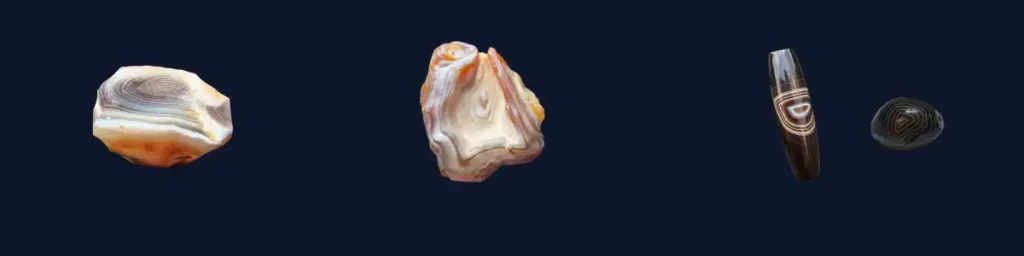
While collectors often celebrate agate for its banded layers and vibrant colors, there exists a rarer, more mystical variant: Silk Agate whose delicate, hair-fine striations converge into perfectly formed natural “eyes” — concentric circles that seem to gaze back at the observer with ancient intelligence. These are not merely geological curiosities. For the spiritual practitioner, the eye-patterned Silk Agate represents awakened consciousness, protective vigilance, and the third eye’s inner vision made manifest in mineral form.
This is not just a stone to wear. It is a stone to work with.
Part I: Understanding Silk Agate — The Geology of Grace
The Science Behind the Silk
Agate itself is a variety of chalcedony, belonging to the quartz family. What distinguishes Silk Agate from common banded agate (known as onyx or sardonyx in Western gemology, and 缟玛瑙 in Chinese tradition) is the extreme fineness of its banding.
Where standard banded agate displays bold, parallel stripes of contrasting color, Silk Agate takes this structure to its evolutionary peak: layers so microscopically thin and densely packed that they resemble woven silk threads — continuous, fluid, and impossibly delicate. Under light, these filaments create a soft, almost fabric-like luminosity that seems to move as the stone turns.
Gemologically, Silk Agate represents the refined end-state of rhythmic crystallization — millions of years of slow, steady silica deposition in ancient volcanic cavities, where each micro-layer records a moment in geological time.
The Eye Pattern: Nature's Most Mysterious Signature
Within the Silk Agate family, the Eye Pattern (often called “Eye Agate” or “Third Eye Agate” in Western crystal communities) emerges when concentric mineral inclusions or differential crystallization creates perfect circular or elliptical formations within the silk-thread matrix. These “eyes” may appear as:
- Concentric halos — radiating rings of subtle color variation
- Pupil-like centers — darker nuclei surrounded by luminous silk bands
- Double or triple eyes — rare formations where multiple eyes appear in symmetrical arrangement
In lapidary and mineralogical terms, these eyes are formed when impurities or trace minerals act as nucleation points, around which subsequent silica layers grow in perfect radial symmetry. The result is a natural mandala — a geometric form that appears across cultures as a symbol of cosmic order and spiritual sight.
Part II: The Eye of the Silk Road — A Cross-Cultural Legacy
From the Heart of Asia to the Ancient World
The story of Silk Agate is inseparable from the Silk Road itself. Unlike jade, which was native to Chinese civilization, Silk Agate originated in the mineral-rich regions of Central Asia — modern-day Afghanistan, Iran, and the Pamir Highlands — where volcanic geology created ideal conditions for these fine-banded formations.
By 2000 BCE, the Bactrian civilization (ancient Afghanistan) had already mastered the art of mining, drilling, and polishing Silk Agate. These early artisans recognized something beyond mere aesthetics: they saw the eye patterns as protective talismans. Archaeological findings from Bronze Age Central Asia reveal eye-patterned agate beads worn as amulets against the “evil eye” — a belief that would later permeate Mediterranean, Middle Eastern, and eventually European folk traditions.
The stone traveled westward along trade routes, reaching ancient Persia, Greece, and Rome, where eye agates were set into rings and breastplates as stones of vigilance and divine favor. Simultaneously, it moved eastward along the Silk Road into China, where Han Dynasty aristocracy (206 BCE – 220 CE) treasured it as a rare import from the Western Regions.
The Han Dynasty Connection: Archaeological Proof of Sacred Status
One of the most significant archaeological validations of Silk Agate’s elite status comes from the tomb of Marquis Haihun — a Western Han Dynasty royal burial site excavated in Nanchang, China. Among over a thousand jade and gemstone artifacts, researchers identified Silk Agate tube beads (catalogued as M1:1878-44) positioned at the waist of the deceased — a placement indicating both protective funerary purpose and high-status personal adornment.
Crucially, these Haihun tomb agates display subtle eye-pattern formations within their silk-fine banding. For Han Dynasty nobility, who believed in the circulation of qi (life force) and the protective power of talismanic objects, eye-patterned Silk Agate served as a spiritual guardian for the afterlife journey — a bridge between earthly existence and higher realms.
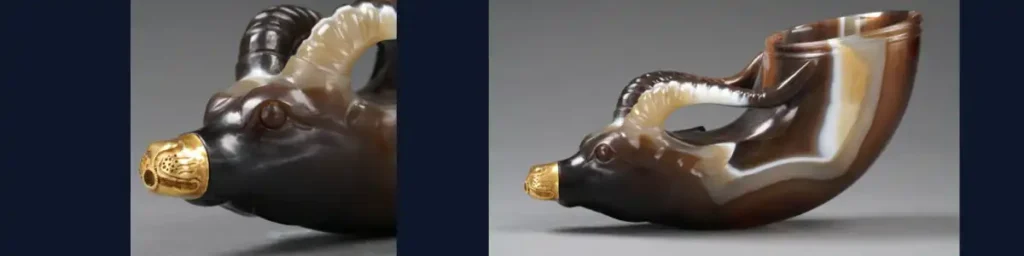
The famous “Golden Cup with Beast Head” , now a national treasure of China, was carved from a single piece of premium Silk Agate and embodies this cross-cultural synthesis: Central Asian mineral, Hellenistic vessel form, Chinese goldwork — a physical manifestation of spiritual and artistic exchange.

Silk Agate of Marquis Haihun
The famous “Golden Cup with Beast Head” , now a national treasure of China, was carved from a single piece of premium Silk Agate and embodies this cross-cultural synthesis: Central Asian mineral, Hellenistic vessel form, Chinese goldwork — a physical manifestation of spiritual and artistic exchange.
From the Heart of Asia to the Ancient World
The famous “Golden Cup with Beast Head” , now a national treasure of China, was carved from a single piece of premium Silk Agate and embodies this cross-cultural synthesis: Central Asian mineral, Hellenistic vessel form, Chinese goldwork — a physical manifestation of spiritual and artistic exchange.
Part III: Metaphysical Properties — Why Eye-Patterned Silk Agate Speaks to the Modern Seeker
1. The Third Eye and Intuitive Awakening
-
The Third Eye Chakra (Ajna) — the center of intuition, inner vision, and psychic perception
-
Spiritual sight beyond physical illusion — the ability to perceive underlying truths
-
Divine watchfulness — the sense of being guided and protected by higher awareness
-
Enhanced clairvoyant imagery or symbolic visions
-
Greater ease entering theta brainwave states associated with deep intuition
-
A sense of benevolent observation — as if the stone itself holds space for the practitioner’s inner journey
2. Emotional Stabilization and Nervous System Regulation
-
Cooling and soothing for anxiety, rumination, and mental scatteredness
-
Regulating for the nervous system — particularly beneficial for HSPs (Highly Sensitive Persons) and empaths who absorb environmental energies
-
Centering — helping to gather fragmented attention back into present-moment awareness
3. Energy Circulation and Meridian Resonance
-
Stimulate stagnant energy flow in blocked channels
-
Balance polarities — harmonizing masculine/feminine, active/receptive, solar/lunar energies
-
Anchor spiritual downloads — helping intuitive insights integrate into physical embodiment rather than remaining abstract
4. Protective Vigilance and Aura Shielding
-
Aura strengthening — particularly the etheric body closest to the physical form
-
Psychic self-defense — creating a field of “watchful awareness” that alerts the wearer to energetic intrusions or manipulative intentions
-
Dream protection — placed under the pillow, it is said to ward off disturbing dream-state intrusions and promote lucid, insightful dreaming
5. Ancestral Connection and Past-Life Recall
-
Access cellular or ancestral memory — particularly for those with passing for old wisdom.
-
Ground past-life recall experiences, preventing dissociation or overwhelm
-
Honor the wisdom of ancient civilizations — serving as a tactile connection to Bactrian, Persian, and Han Dynasty spiritual technologies
Conclusion: The Eternal Watchers
May your inner eye open to the silk-thread wisdom of the ages.
For a clearer guide to Buddha Eye, Phoenix Eye, Crystal Eye, Vajra Eye, and Third Eye meanings, read our updated Silk Agate Eye Patterns Guide.