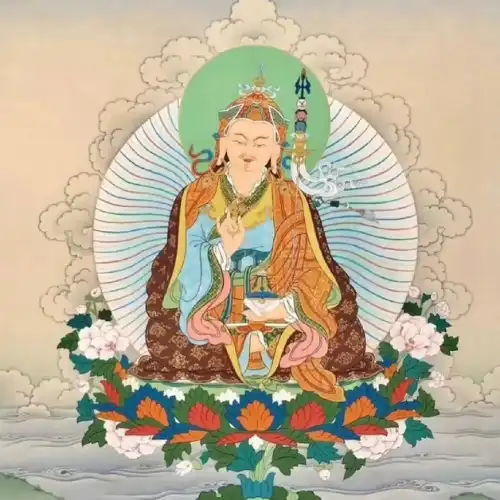
Why Meditation Isn’t Working: A Tibetan Practice for Inner Stillness
Have you ever sat on your meditation cushion, perfectly cross-legged, back straight as an arrow, focusing intensely on your breath—only to find your mind screaming, your legs numbing, and your anxiety skyrocketing?
You are not alone. Thousands of modern meditators perform this daily ritual, treating mindfulness like a gym workout where rigid physical posture equals spiritual success. But weeks, months, or years go by, and true inner peace—that deep, spacious state of profound stillness—remains frustratingly out of reach.
Why is it so hard to quiet the mind?
The answer was uncovered 1,200 years ago on the high-altitude plateaus of Tibet. The great master Padmasambhava (The Lotus-Born Guru) looked at his most dedicated students, who were meditating hours a day with iron discipline, and shook his head.
“You think stillness depends on how straight you sit? You think meditation is about controlling your breath?” he asked. “The physical posture is just the outer shell. You have hijacked the true purpose of practice.”
Padmasambhava then revealed a legendary shortcut to instant stillness—a timeless secret that has nothing to do with fighting your thoughts, and everything to do with hacking the physics of awareness.
 The Secret Weapon: Radical Non-Interference
Most modern meditation advice tells you to focus, label, or gently push away distractions. But Padmasambhava taught the exact opposite: Radical Non-Interference.
In ancient Tibetan texts, this is famously known as the practice of The Three “Whatevers” (三不管). When you sit down to meditate, instead of trying to silence your brain, you sign a temporary peace treaty with reality across three dimensions of time:
1. Drop the Past (不管过去)
The past is nothing but a phantom—a dream sequence that has already finished. Yet, the moment we close our eyes, we begin rehearsing old conversations or replaying old regrets. The first rule is simple: Let the past be. If an old memory pops up, do not analyze it. Do not dive into its story. Let it dissolve like vapor.
2. Leave the Future Alone (不管未来)
The future is an unwritten script, a projection of smoke and mirrors. Trying to plan your day, anticipate your worries, or manifest your goals while meditating is a waste of mental energy. The second rule: Let the future be. Whatever hasn’t happened yet is none of your business right now.
3. Do Not Touch the Present (不管现在)
This is the ultimate game-changer. When a thought arises right now—whether it’s a brilliant business idea, a sudden worry, a judgment, or a random itch—do absolutely nothing about it. Do not try to suppress it. Do not try to breathe it away. Do not follow it.
Modern mindfulness often feels like an exhausting game of Whack-a-Mole—repressing thoughts as they pop up. Padmasambhava laughed at this approach, noting that the mind is like muddy water: the more you stir it to clean it, the dirtier it gets. If you leave it completely alone, it settles into crystal clarity all by itself.
 Step Inside the Cinema: Discovering the “Observer”
But you might ask: “If I am not controlling my thoughts, where does my mind go? Am I just spacing out?”
This brings us to the core of this ancient masterclass: Resting in Pure Awareness (安住本觉).
Think of your mind as a giant movie screen. Your thoughts, anxieties, plans, and emotions are the movie playing on it. When you practice the Three “Whatevers,” you stop jumping into the screen to fight the actors or rewrite the script. Instead, you walk backward, sit in the theater seat, and become The Observer.
Ask yourself this liberating question during your next session:”Thoughts are passing by. But Who is the one noticing these thoughts?”
Behind the chaotic traffic of your thoughts lies a quiet, unshakeable presence—your pure awareness. This awareness has no color, no shape, and no size, yet it is undeniably alive, clear, and perfectly still. It cannot be stained by bad thoughts, just as a movie about a heavy storm cannot make the physical screen wet.
Real meditation is not about creating a new state of mind; it is about recognizing the unshakeable stillness that has been inside you all along.
 The 4-Step Checklist for Effortless Flow
To bring this ancient wisdom into your daily routine, memorize these four simple mental toggles taught by the master:
1. Relax (松):
Unclench your jaw. Drop your shoulders. Drop any expectation of what a “good meditation” should feel like. Treat yourself as if you have absolutely nowhere to go and nothing to fix.
2. Anchor (定):
Keep your attention lightly resting on the Observer, not on the drama of the thoughts. When a stray thought tries to pull you away, simply step back into pure witnessing.
3. Awaken (明):
Stay sharp and vivid. This isn’t a state of sluggish daydreaming or sleepiness. You are fully awake, highly alert, yet completely at rest—like a still, glassy lake reflecting a clear blue sky.
4. Dissolve (空):
Realize that everything passing through your awareness—the distant traffic sounds, the physical sensations, the fleeting emotions—is just passing weather. Let them come, and let them go.
 Bringing Meditation into the Chaos of Real Life
The ultimate beauty of this secret is that it liberates you from the cushion.
You don’t need a perfectly quiet room, incense, or an expensive setup to be in a deep meditative state. When you are walking, be the awareness that knows you are walking. When you are eating, cooking, or answering an email, rest in the silent space that witnesses the action.
The world around you will continue to change, but your inner anchor remains completely untouched—spacious, protected, and free, like the sky itself.
Stop fighting your mind. Stop trying to “do” meditation. Just step back, apply the Three “Whatevers,” and come back home to yourself.
 References & Canonical Sources
To honor the authentic lineage of these teachings, we cross-reference the canonical root texts and historical transmissions from the Tibetan Buddhist tradition:
<
| 汉文名称 / Canonical Title | 藏文原名 / Tibetan Name | 英文权威名称 / English Translation Title | 作者与传承 / Lineage & Speaker | 典籍类型 / Text Classification |
|---|---|---|---|---|
| 《松岭宝藏》 | Gonpa Tashi Chi | Treasures from Juniper Ridge: The Profound Instructions of Padmasambhava to the Dakini Yeshe Tsogyal | Spoken by Padmasambhava, recorded by Dakini Yeshe Tsogyal.(Revealed by Terma master Nyang Ral Nyima Özer) | 伏藏典籍(Revealed Treasure Text / Terma) |
| 《大圆满前行》(龙钦宁提前行) | Longchen Nyingthig Ngöndro | Longchen Nyingthig Preliminaries | Jigme Lingpa(Founder of the Longchen Nyingthig tradition) | 原创前行法本(Original Preliminary Root Text) |
Brought to you by Kris Nature — Curating authentic ritual items, talismans, and natural stone essentials to support your daily mindfulness and spiritual practice.