
Silk Agate: The Complete Guide to Earth's Most Grounding Crystal (2026)
Last updated: August 2026 | Reviewed by Glint & Grain Crystal Specialists
What You'll Learn
- What Is Silk Agate? Geology vs. Myth
- Silk Agate vs. Regular Agate, Eye Agate & Dyed Agate
- What Silk Agate Is NOT (Four Common Confusions)
- Silk Agate Meaning & Symbolism
- 5 Symbolic Qualities Inspired by Its Structure
- How to Use Silk Agate Daily
- Who Should (and Shouldn't) Wear It
- How to Cleanse & Care for It
- FAQ: Authenticity, Price, Zodiac, Sleep
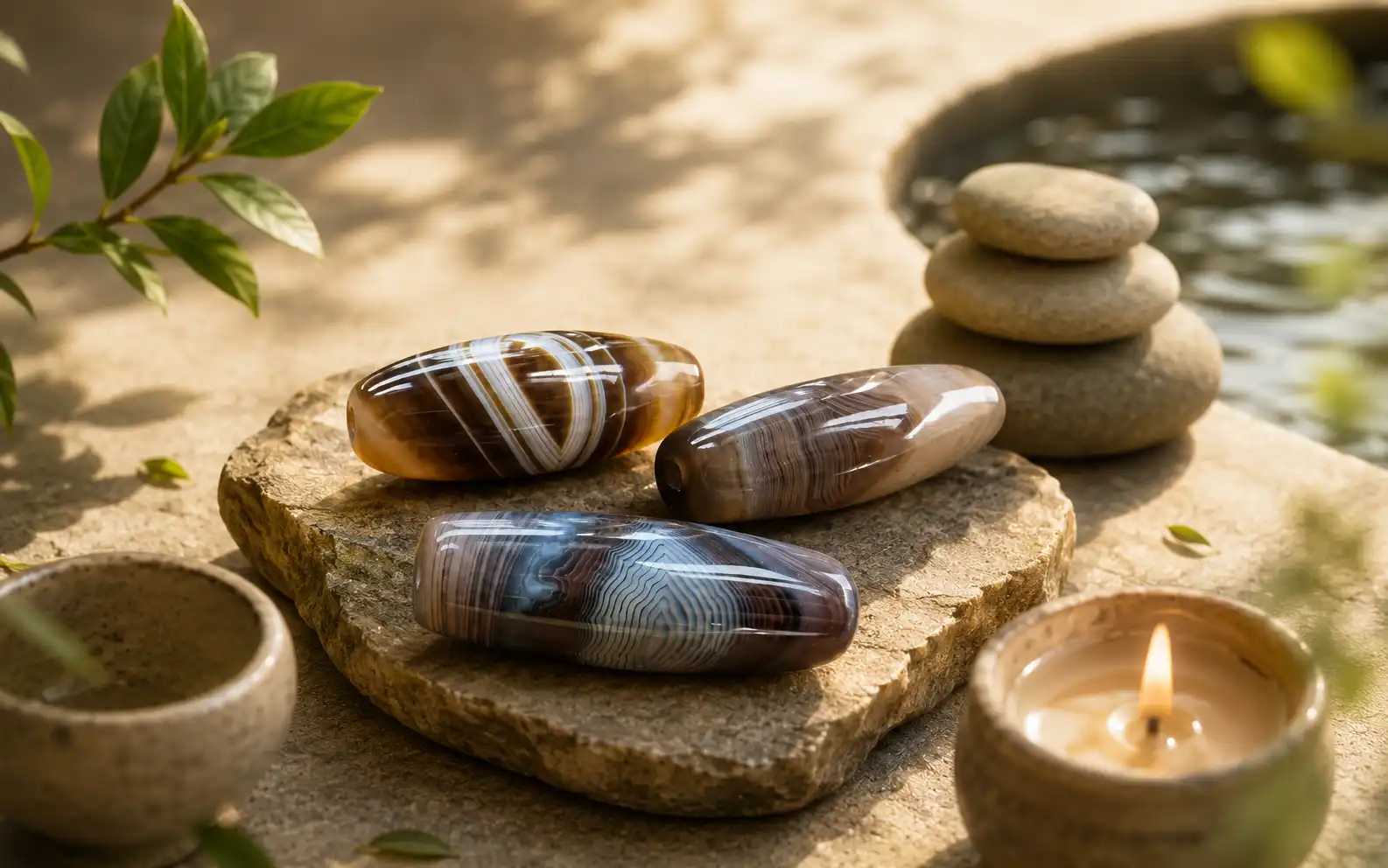
A natural silk agate pendant with hair-thin parallel bands — every line is a growth cycle frozen in stone.
What Is Silk Agate? Geology Meets 3,000 Years of History
Silk agate is a microcrystalline quartz (chalcedony) variety, but calling it "just another agate" misses the point. While standard banded agate displays thick, bold stripes, silk agate forms through a rare geological process that deposits microscopic, parallel silica layers — so fine they resemble woven silk threads trapped in stone.
How It Forms
Each thread-like band represents a distinct growth cycle. Mineral-rich water seeps into volcanic rock cavities, depositing silica one molecular layer at a time over millions of years. The result is a natural timeline: pressure, pause, settle, repeat. In crystal culture, this ordered, self-contained structure is often described symbolically as "closed" or "settled" — the visual source of the stone's association with steadiness.
Historical Evidence (Not Just Legend)
- Silk Road traders carried banded agates as currency and protective talismans across Central Asia.
- Roman soldiers wore banded agate amulets into battle, trusting the stone's dense layers as symbols of endurance.
- Chinese Han Dynasty nobility buried finely banded agate in royal tombs — including the Marquis of Haihun tomb, where archaeologists documented exquisitely preserved banded agate artifacts, confirming the stone's cross-cultural value as far back as 74 BCE.
Source: Archaeological findings from the Jiangxi Provincial Museum, Marquis of Haihun excavation reports (2015).
Silk Agate vs. Regular Agate, Eye Agate & Dyed Agate
Most confusion about silk agate comes from four names that sound interchangeable but are not. This table is the fastest way to tell them apart:
| Name | What It Actually Is | How the Pattern Forms | What to Check Before Buying |
|---|---|---|---|
| Silk Agate | Natural banded chalcedony with hair-thin parallel layers | 100% geological — rhythmic silica deposition in volcanic cavities | Fine, continuous threads with soft, organic edges |
| Regular Banded Agate | The broader chalcedony family silk agate belongs to | Geological, but with thicker, more irregular bands | Band thickness — silk agate's layers are visibly finer |
| Eye Agate | Not a separate stone — a pattern variant of banded agate | Geological — bands fold into concentric circles | Whether the "eye" is a natural circle or an etched motif |
| Dyed Agate | Real agate with artificially added color | Geological base + human-applied dye | Color pooling along cracks or drill holes; whether the seller discloses treatment |
One distinction matters especially to collectors: the "eyes" in eye agate are formed by geology, while the eyes on traditional dzi beads are applied by craftsmen through etching. Both are legitimate — but they are different categories of object, priced and valued by different logic. We apply the same honest labeling to our own collection: genuinely untreated stones are labeled Natural • Untreated; dyed or heat-treated pieces state the treatment openly on the product page; and hand-etched pieces are labeled Traditional Craft — never sold as "natural pattern."
What Silk Agate Is NOT (Four Common Confusions)
- It is not a dyed stone by definition. Silk agate's banding is geological. Dye can be added afterward — and often is, on cheaper material — but that is a treatment, not part of what the stone is.
- It is not an etched dzi bead. Dzi patterns are applied to agate by artisans. Silk agate's threads and eyes form inside the rock with no human involvement.
- It is not "high-vibration." In crystal culture it sits at the opposite end of the spectrum — chosen for steadiness, not intensity.
- It is not rare in the way sellers sometimes claim. Fine, high-clarity silk agate is genuinely uncommon, but the stone itself is a real, obtainable material. Be skeptical of scarcity language used to justify inflated prices.
Silk Agate Meaning & Symbolism
The stone's physical structure directly informs how practitioners interpret its symbolism:
- Balance — Alternating light and dark layers are read as yin-yang harmony: order emerging from chaos.
- Protection — The dense, layered structure is traditionally seen as a symbolic shield between the wearer and external pressure.
- Patience — Its slow formation, one layer at a time, is taken as an emblem of sustainable, long-term growth.
In modern crystal practice, silk agate is classified as a grounding stone rather than an activating one. Wearers tend to describe it in low-key terms — steady, quiet, settling — which is precisely why it is recommended to people who find more intense stones uncomfortable.
5 Symbolic Qualities Inspired by Silk Agate's Structure
Crystal symbolism is subjective — but in silk agate's case, each traditional meaning maps visibly onto the stone's actual geology. Here is what practitioners consistently associate with it:
1. Grounding Presence
Unlike brighter stones that can feel visually intense, silk agate is often described by wearers as slow, steady, and grounding. Its ordered bands provide a tactile focal point: a physical reminder to slow down and return to the present.
How to use it: Hold a palm stone during moments of stress or high-pressure meetings. Run your thumb across the silk threads. The tactile repetition works as a simple sensory anchor — a grounding technique long used in mindfulness practice, with or without a stone in hand.
2. Emotional Processing Without Overwhelm
Practitioners describe silk agate as supporting "clarity distance" — the ability to observe anger, grief, or stress without being submerged by them. In symbolic terms, it is associated with steadying mood swings and emotional reactivity rather than suppressing them.
3. Meditative Focus
The stone's ordered geometry gives the eye and the hand a predictable pattern to follow. Many beginners find that tracing the parallel bands provides a more concrete focus than breath-counting alone — a practical aid for settling into meditation.
4. A Symbolic Boundary for Sensitive Wearers
In crystal tradition, silk agate's dense structure symbolizes a filter: remaining open and compassionate while letting other people's stress stop at the perimeter. It is traditionally recommended for empaths, healthcare workers, therapists, and anyone spending their days in crowded environments.
5. Restful Evening Rituals
Many wearers keep silk agate on a bedside table as part of a calming evening ritual — a quiet, visual cue to wind down. Some describe waking with a sense of mental clarity they associate with the routine rather than with the stone alone.
How to Use Silk Agate in Everyday Life
You don't need elaborate rituals. This stone rewards consistency, not complexity.
- Wear It Daily — A pendant resting against the chest, or a bracelet on the non-dominant wrist, keeps the stone in contact with your day. Choose pieces where the silk threads are clearly visible — the pattern is the point.
- Desk Anchor for Work Stress — Keep a palm stone within reach. When overwhelm builds, pick it up, trace the bands for 60 seconds, and breathe. The gesture interrupts the stress spiral and gives your attention somewhere simple to land.
- Meditation & Yoga Companion — Hold it during practice or place it on your mat. Its weight and texture provide somatic grounding, useful for meditators who feel unfocused with lighter practices.
- Home Accent — A polished piece in a living space or bedroom works as a visual reminder of the tone you want the room to hold.
- Crystal Grid Centerpiece — In grid arrangements, practitioners use it as the anchor stone for grounding-themed layouts, where its steady symbolism balances more intense surrounding stones.
Who Should Wear Silk Agate? (And Who Shouldn't)
Often chosen by:
- Empaths and highly sensitive people
- People with overactive minds or a tendency toward anxiety
- Meditation beginners who struggle to "quiet the noise"
- Anyone working in high-stress, crowded environments
- Those seeking long-term steadiness rather than quick fixes
Less suited for:
- Anyone expecting instant, dramatic effects — silk agate's symbolism is about consistency, and its fans are the first to say so
- Those who want a bold visual statement — its beauty is subtle and reads best up close
- Buyers unwilling to verify what they're purchasing — as with any popular stone, treated and imitation material circulates widely
How to Cleanse & Care for Your Silk Agate
Physical Maintenance
- Clean: Soft, damp cloth only. Avoid chemical cleaners — they can dull the fine surface layers.
- Store: Away from direct sunlight and extreme heat. Prolonged UV exposure can fade natural coloration over years.
- Durability: Mohs hardness 6.5–7. Resistant to scratches, but it can fracture if dropped on a hard surface.
Traditional Refreshing Practices (Every 2–4 Weeks, Optional)
- Water rinse: Hold under cool running water for about 30 seconds. Pat dry immediately.
- Moonlight: Leave overnight during a full moon — a widespread modern practice.
- Sage or palo santo: Pass through the smoke as a ritual of release.
- Sound: Some practitioners use singing bowls or tuning forks as part of their routine.
Warning: Do not use salt water or salt beds. Salt can abrade the fine surface layers and dull the silk-thread clarity.
For step-by-step instructions on each method, see our guide: How to Cleanse Your Stone: 4 Methods That Actually Work. And for the complete daily routine beyond cleansing: How to Care for Your Silk Agate & Tibetan Dzi.
Frequently Asked Questions
Is silk agate the same as regular banded agate?
No — though you will sometimes see it called "silk banded agate," which confuses things. Both are chalcedony, but silk agate's layers are microscopically thin and parallel, creating the thread-like "silk" appearance. Standard banded agate has thicker, more irregular stripes. In crystal culture, the finer structure is associated with a steadier, quieter character.
What is eye agate? Is it different from silk agate?
Not a different stone — the "eye" is a pattern, not a material. When silk agate's parallel bands fold into concentric circles, the result looks like an eye. Collectors call these pieces eye agate, and the eye is one of humanity's oldest protective symbols, traditionally believed to watch over the wearer. Not every silk agate forms an eye — when one does, it is considered the stone's most expressive form. We wrote a full guide: silk agate eye patterns and their meanings.
How can I tell if my silk agate is real?
First, separate two questions: is the stone real agate, and is the color natural? The stone part is easy — agate ranks 6.5 to 7 on the Mohs scale, so real agate scratches glass, while plastic, resin, and glass imitations do not. Color is trickier. Natural silk agate shows soft, organic bands with slightly blurred edges, and the color inside the drill holes stays consistent with the surface. On dyed stone, color often pools along cracks or looks darker around the holes. Keep in mind: dyed agate is still real agate — what matters is whether the seller told you. If a vivid "rare" piece is suspiciously cheap, the missing information is usually in the treatment column. For the full picture, see how red agate is treated.
What is silk agate good for?
In crystal tradition, it is associated primarily with grounding, emotional steadiness, symbolic protection, and meditation support. Its quiet character suits people who find high-intensity crystals overwhelming.
Can I sleep with silk agate?
Yes — many wearers keep it on a bedside table or under a pillow as part of a calming evening routine. Its symbolism is non-stimulating, which is why it is traditionally recommended for bedrooms.
Which zodiac signs is silk agate associated with?
Any sign can wear it. In modern crystal astrology, Earth signs (Taurus, Virgo, Capricorn) and Water signs (Cancer, Scorpio, Pisces) are most often matched with it, reflecting their traditional affinity for grounding and emotional reflection.
How much does real silk agate cost?
Quality varies by origin and thread clarity. Small tumbled stones typically range from $8–$25. High-clarity palm stones or jewelry-grade pieces with visible silk threading run $40–$150. Exceptional museum-grade specimens can exceed $300. If a piece is priced far below these ranges, check whether treatment has been disclosed.
Final Word: Choose Consistency Over Intensity
The modern wellness market sells crystals as quick fixes. Silk agate points the other way: its meaning is built from slowness — millions of years of one layer at a time.
It will not promise miracles. What it offers is a natural object that no machine can repeat, a pattern no other stone shares, and a daily reminder that steady things are built slowly. In a world engineered to fragment your attention, that is its own kind of value.
Explore Silk Agate Jewelry
Every silk agate piece at Glint & Grain carries one honest material label: pieces that are genuinely natural and untreated are marked Natural • Untreated, and any dyeing or heat treatment is stated plainly on the product page. Photographs are never retouched — the stone you see is the stone you receive. ALGT certificates are available on request for an additional fee — please allow 5–7 extra working days for certification. Browse the silk agate collection — from the Classic Silk line to Desert Wind, Snow Vein, and Honey Song.
Disclaimer: The meanings of silk agate described in this article are symbolic and cultural. They are not medical claims or guaranteed effects. Instead, they offer a way to connect with natural agate through intention, beauty, and personal reflection. Nothing here is intended to diagnose, treat, cure, or prevent any medical or psychological condition, nor should it replace professional medical advice.