
Buddha Is Not a God — It's the Future You, Awake
The statue in a temple is not a god. It might be you, awake.
That is the first thing Buddhist teaching asks you to understand, and everything else follows from it. Buddha is a job description, not a name — it means an awakened human being. The figure on the altar is not there to grant favours. It is just a reminder: a person can wake up.
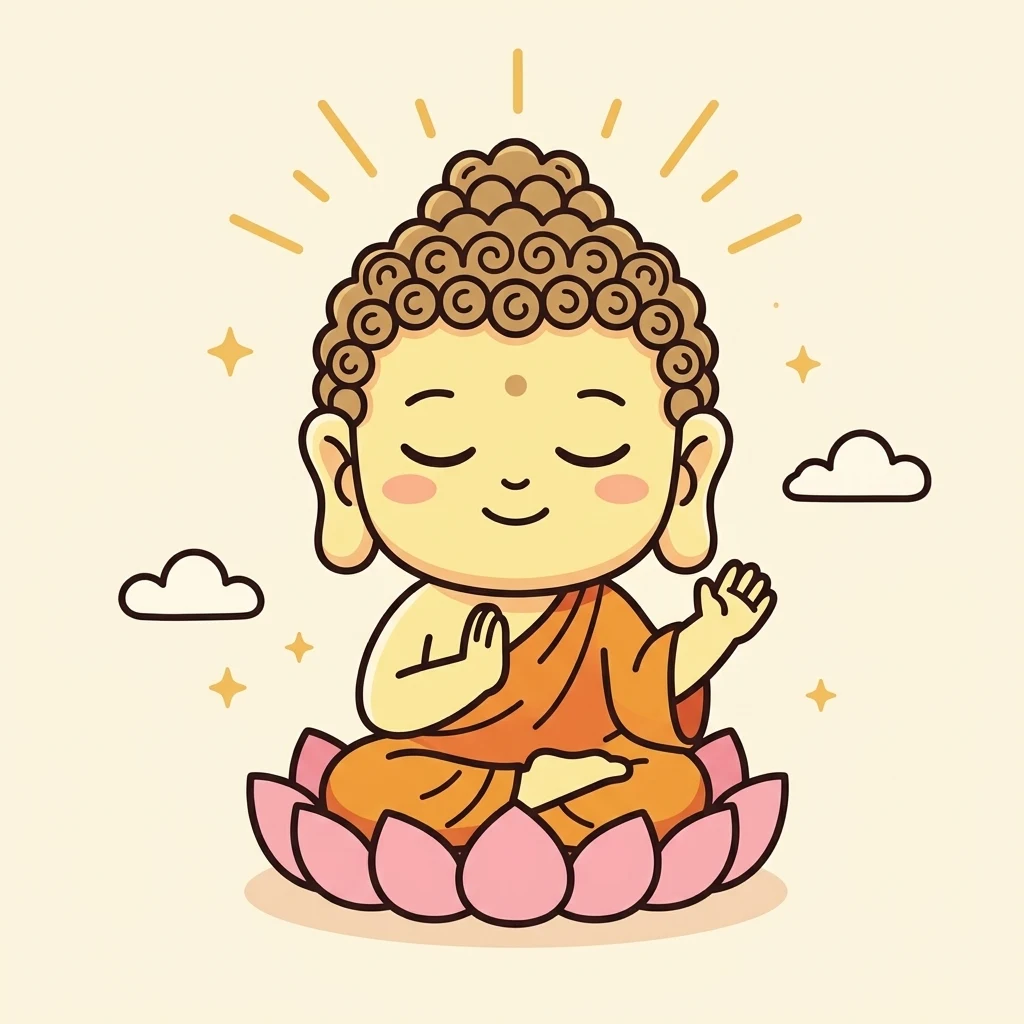
Not a god — just a reminder to wake up, drawn with a smile.
Once you see that, the rest of the teaching stops being a religion you join and starts being a manual you can actually use: why life so often feels off, what keeps it that way, and what to do about it.
So What Is the Teaching Actually About? One Word: Suffering
Strip Buddhism down and it is about a single problem: how to suffer less. Not just physical pain — the teaching casts a wider net than that. It counts the limits you keep hitting, the fears that won't shut up, the dissatisfaction that shows up even when things are fine, the feeling that your own life is not quite under your control. All of that goes in the same bucket.
That sounds gloomy until you notice the order of operations. The teaching names the problem first, the way a doctor names a symptom, and then it gets to work on causes. A diagnosis is only depressing when nobody offers a treatment. This one does.
You Were Born Doing It
Here is the part nobody remembers. Watch a newborn: crying, fists clenched, legs kicking at nothing — a small protest against having arrived at all. And there is no going back. From day one, everything you have ever learned was paid for in discomfort.
Learning to walk? Falling, over and over, with people watching. Learning to talk? Being misunderstood for a year. Every new room full of strangers, at six or at forty, means a stretch of awkward before anything feels easy. Nobody could take those steps for you. A parent can hold your hand. A parent cannot walk for you.
The teaching does not say discomfort is good or that you should go looking for more. Falling, awkwardness, walking up to strangers — that is the sticker price of growing, and everyone pays it. What turns it into lasting pain is something we add ourselves: one part trying to hold the good parts still, one part hunting for a detour around the falls. The extra pain is homemade.
Wanting to Hold On, Wanting to Run
Here is something you can watch for yourself. Two people go through the same bad month: one hurts for a while and turns the page, the other hurts for ten years. The extra pain usually isn't coming from the event. It was added — by us.
There are two ways we add it. The first is wanting to hold on. We want the good stretch to stay paused, the people we love to stay exactly here, the kids to stay small — and everything keeps changing anyway, because change is the one rule on this road that never bends. Hold on as hard as you like: it won't hold. The second is wanting to run. The conversation we won't have, the step we won't take, the fall we keep routing around — the routing around costs more than the fall ever would. You can't outrun it either.
So the teaching has one plain sentence for this: let what comes come, let what goes go, and take the steps that are yours — all of them. This is not fatalism. Fatalism is lying down. This is spending your strength on the walking instead of the dragging.
The Guy Who Started It All Had Everything
Buddhist teaching traces back to Siddhartha Gautama, a prince in what is now northern India, around the fifth century BCE. By the traditional account he had it all — wealth, power, comfort, every pleasure a kingdom could arrange. And he was still unhappy. So he walked out and sat with one question: if a person can have everything and still feel this way, what is a life actually for?
Notice what that question implies. If even a prince with everything sat up at night, then the problem was never the stuff. It lives somewhere in the mind — maybe in whatever we are at root.
Nobody Is Born at the Top of the School
A common way of mapping the tradition is a school. The Buddha is the principal. Bodhisattvas — beings who, in the Mahayana schools, keep coming back to help others wake up — are the guest professors. Monks are the regular teachers. And the rest of us, the ones who haven't started or just started, are the students.
Hold onto one thing from that picture: the distance between the principal and the student is measured in practice, not in birth. The teaching says anybody can wake up. Nobody is born at the top of the building — you get there by study, or you don't get there. That is a much more democratic setup than royalty, and it is the point.
The Three Habits That Keep You Stuck
If suffering has a machinery, the teaching says it runs on three habits, traditionally called the three poisons: ignorance, anger, and greed. They are called poisons, not sins, for a reason you can use: a sin is an offence against an authority. A poison is something that hurts the person holding it first. These hurt you before they hurt anyone else.
1. Not Knowing (They Call It Ignorance)
This does not mean stupid. It means not seeing how your situation actually works — including your own part in it. And every single human starts there. You arrived knowing nothing: someone had to teach you to walk, to talk, to tell a real danger from a loud one.
The tradition's image is light. Knowledge and wisdom are light on your path — the more you have, the further you can see. This is a quietly practical claim: a lot of the times you feel helpless or small, the real problem is not you. It is that you are standing in a dark room. Turn the light on — learn how the thing actually works — and the room usually turns out to be smaller than it felt.
2. Anger — the Hot Stone You Are Holding
Picture it: you pick up a stone that has been sitting in a fire, and you throw it at someone. Whose hand burns first? Yours. The stone lands later.
That one image is the whole teaching on anger. Anger is pain that has found a direction. Something hurt, the hurt reached for a target, and now there are two people hurting instead of one. You are not being told to never feel it. You are being told to watch the gap between the heat and the throw — because one breath inside that gap usually changes what happens next. The person who calms down first is not the weaker one. They are the one who stops paying the bill.
3. Greed — the Want With No Finish Line
Greed is not wanting things. Wanting things is normal. Greed is wanting without a stopping rule: I want a million. Got it. Now ten million. Got it. Now a different million, because the first one stopped feeling like anything.
The old image is drinking salt water to quench your thirst — every sip makes the next one necessary. The modern version: every want you satisfy signs you up for maintenance — storage, insurance, envy, the low hum of "what if I lose it." The wanting promises the wanting will end. It never does. That is not a moral judgement. It is just how the machine is built, and you are allowed to notice.
What You're Actually Supposed to Do
No ceremony, no test to pass. As the tradition puts it: you are already a Buddha who hasn't woken up — unawakened, and a Buddha at once. So the work is not to become someone else. It is to see yourself clearly: to watch yourself, to understand yourself, and — harder than both — to be on your own side.
Turn the gaze a few degrees. Most thoughts in a day start with "I want" — that thing, that life, that version of yourself. There is nothing wrong with wanting. But it holds the eyes on what isn't there yet. The turn the teaching suggests is a small one: from "I want" to "I already am." Whole enough. Enough. Already carrying everything the waking up requires. Then go back to what is in your hands — this meal, this call, this next step — and do it properly. Live earnestly.
Awakening is not fireworks, and it is not becoming someone else. It is more like peeling an onion: layer after layer of "it has to be this way," layer after layer of "what will people think" — and underneath the layers there is no one new. There is you. The journey does not end by arriving somewhere. It ends by finally becoming yourself.
People who have practised for decades tend to describe the result as quiet. Nothing about it photographs well — and that is rather the point. You were not put here to perform being at peace. You were put here to be at peace, on a Tuesday, doing the dishes.
Two pieces on this site work the same ground from different angles. The Tibetan approach to inner stillness looks at why forcing your mind quiet tends to backfire. And the copper bead as a bridge to mindfulness follows the same logic in material form — a small object that carries the reminder through an ordinary day.
Three Honest Limits
Three cautions belong with everything above. First, this is a description of a tradition as it is commonly taught, not a prescription for your life — the schools disagree on plenty, and a Thai forest monk and a Tibetan lama would answer several of these questions differently. Second, none of this is therapy. Buddhist ideas about suffering are not a treatment plan, and the tradition itself says some conditions need medicine — if you are struggling, that is what qualified professionals are for.
Third — the one most often misheard: talking about suffering is not telling you to put up with harm. If someone is hurting you, this teaching does not ask you to smile through it. Step one is seeing clearly where the pain comes from — and once you see that, the next move tends to make itself known. Enduring is not the practice. Seeing clearly is.
To be candid: we have a soft spot for silk agate. It carries a quiet kind of energy — nothing showy — and worn day after day, it slowly brings up its glow. It keeps reminding us of something: a life works the same way, raised little by little, until one day it lights from within.
So pick a silk agate piece you like, wear it, and don't rush to see the difference. Let it change with you — you bring up its glow, and it keeps you company while you become yourself. That may be the most concrete form self-love takes: unhurried, one ordinary day at a time.
FAQ
Is Buddha a god?
No. Buddha is a title meaning "awakened one," given to a human being who is said to have woken up. In the teaching, the statue represents what a person can become — which is why practice, not worship, sits at the centre of the tradition.
What does suffering mean in Buddhism?
More than physical pain. The teaching counts limits, fear, dissatisfaction, and the sense that your life is not under your control as forms of suffering too. Naming all of that is the first step of the diagnosis — and the diagnosis is what the rest of the path treats.
What are the three poisons?
Ignorance, anger, and greed — the three habits said to keep suffering running. They are called poisons because they damage the person holding them first: anger burns the hand before the stone lands, and greed creates the thirst it promises to quench.
Can anyone become a Buddha?
The teaching says yes. The gap between an awakened person and everyone else is measured in practice rather than in nature or birth, which is why calming the mind, doing the right thing, and keeping on learning are held to be open to anyone willing to repeat them.
Does Buddhism say desire is bad?
No. The target is craving without a stopping point, not ordinary wanting. Wanting food, company, or good work belongs to a normal life. The problem starts where getting the thing fails to end the wanting — and the search continues with the same appetite.
Why do some things hurt for a week and others for ten years?
Usually the difference is not the size of the event — it is what we add on top of it. Trying to hold on to what already left, or running from what actually needs facing, keeps a wound open long after the original cut has healed. When the teaching talks about "letting go," this extra layer is what it means — not the pain itself.