
How to Tell if a Tibetan Dzi Bead Is Real (and What It's Worth)
A real Tibetan Dzi bead is not one single thing: it is either a genuinely handcrafted Tibetan-style bead, a naturally patterned eye-stone, or an ancient original — and knowing which of the three you are looking at is the entire game. Most of what is sold online as an "ancient" Dzi is a modern bead with a story attached, so this guide covers the four questions buyers actually ask — how to tell if a Dzi is real, why Dzi beads cost what they cost, what real ones are worth today, and whether you can wear one to sleep — plus the family tree the collector market uses, and what laboratory testing can and cannot actually prove.
How Can You Tell if a Dzi Is Real?
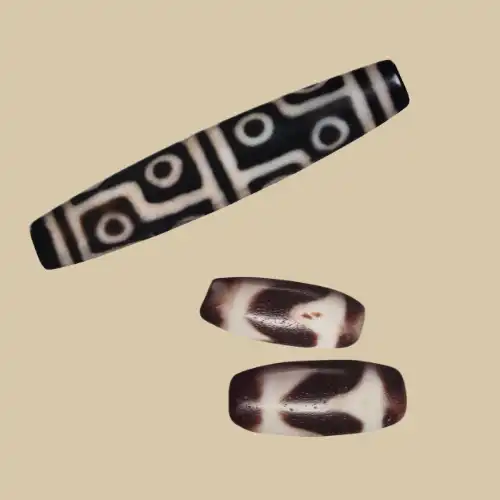
You can tell if a Dzi is real by first deciding which kind of "real" you mean, then checking material, pattern, price, and story against that category. A genuine modern Tibetan-style Dzi is real craftsmanship on natural agate; a natural Mongolian eye-stone is a real geological pattern; an "ancient" Dzi from an ordinary shop is, more often than not, a modern imitation with an antique claim.
Here is the five-point check we use when a bead comes across our table:
- 1. Identify the category first. Tibetan-style Dzi are natural agate with hand-applied etched patterns and a treated patina — a traditional craft. Natural eye-stones carry patterns formed by geology. Ancient originals are a separate, museum-grade world. Ask the seller which one you are buying; an honest seller answers in one sentence.
- 2. Look at the pattern's origin. Under a loupe, an artisan-etched pattern shows deliberate, crisp lines in inherited motifs — classic eye counts, tiger-tooth stripes, sacred symbols. A naturally banded eye-stone shows organic, flowing layers with no brush or chisel logic. Neither is "fake"; they are simply different categories that must be labeled honestly.
- 3. Test the material. Agate is a microcrystalline quartz with a hardness around 6.5–7 on the Mohs scale — it feels cool to the touch and resists scratching from a steel knife. Glass and resin imitations scratch easily and warm up quickly in the hand.
- 4. Treat the age claim with suspicion. Genuine ancient Dzi are extremely rare, and the overwhelming majority of beads marketed as "old" or "excavated" are modern beads with an invented history. If the price is retail-accessible, the bead is almost certainly not ancient — that is not a flaw, it is simply how the modern market works.
- 5. Read the label, not the story. A reputable seller discloses material and treatment in writing: "Traditional Craft" for hand-etched Tibetan-style, "Natural Stone • Crafted Shape" for natural eye-stones, and any color treatment piece by piece. Certificates claiming ancient origin deserve extra scrutiny — many are decorative documents.
What "real" does not mean: real is not a guarantee of age, and natural is not a synonym for "old." A modern handcrafted Tibetan-style Dzi can be completely authentic; a "two-thousand-year-old" bead from a souvenir stall usually is not what it claims to be.
The Six Things the Collector Market Actually Looks At
In the Chinese-speaking collector market, an old bead is judged on six visual features, in this order:
- Form. The bead's proportions and symmetry — how the body sits, whether the ends taper, whether the shape matches a known type.
- Bore. The hole itself — how it was drilled, how it has worn, and whether the openings have been polished smooth by years of cord.
- Weathering. Surface texture — the fine age marks and small surface pits that time and handling leave on agate.
- Patina. The soft sheen that builds up on a bead worn and handled for a long time, as opposed to a fresh machine polish.
- Inlay and pattern. How the pattern sits in the stone — whether the motif was laid into a whitened ground and bitten in deep, and how the edges of the pattern have aged.
- Staining. Colour drawn into the stone from its burial environment — the subtle colour shifts old buried beads often carry.
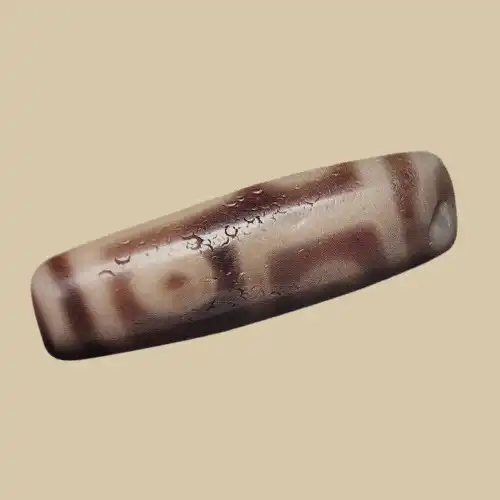
These six features are the market's standard, and they are the mainstream way old beads are judged — but the method has a structural problem. There are no agreed standard reference pieces to compare against, and the old craft itself was lost, which is why dating these beads is genuinely difficult even for experts. Surface features also get imitated: modern ageing treatments can reproduce weathering and patina in part. And one popular "proof of age" is simply wrong — the red spots often described as cinnabar on a bead's surface cannot be used for dating. "Looks right" and "is old" are two different statements.
Why Is Dzi So Expensive?
Dzi beads occupy two separate worlds with two separate price logics: modern handmade beads are priced by artisan labor and honest materials, while genuine ancient beads are priced by extreme scarcity — and the second world almost never appears in a retail shop. When a price looks shocking, it is usually the antique story doing the pricing, not the stone.
Six factors drive Dzi value:
- Material. Natural agate with fine banding is the canvas; harder, cleaner stone commands more.
- Handwork. A Tibetan-style Dzi is etched and patinated by hand, pattern by pattern, in a process that takes days — labor is real cost.
- Pattern rarity. Certain classic eye counts and motifs are rarer and more requested than others; rarity of pattern, not magic, moves price.
- Geological origin (for natural stones). A naturally patterned stone's eyes were formed over millions of years and can never be repeated — each one is a one-of-one piece of geology.
- Age (for genuine antiques). True ancient Dzi are scarce cultural objects; their value is collector value. As we noted above, most "ancient" beads in circulation are modern.
- Market storytelling. The more exotic the claim, the higher the markup. An honest label removes this factor entirely — which is exactly why we publish one.
How Much Are Real Dzi Beads Worth?
Real Dzi prices split into three worlds, and the gaps between them are enormous. A genuine antique Dzi — pre-Tang, in good condition — is a collector object: prices start around US$140,000 (roughly RMB 1,000,000) and run into the tens of millions. A new Dzi made with the traditional process is honest contemporary craft, priced by technique and labor at roughly US$50–5,000. Below both sits the imitation market: beads that are not even agate, or that skip the real process, sell for about US$5–20. There is no honest continuum between these three tiers — the confusion in the market comes from sellers pretending there is.
| Tier | What it is | Honest label | Typical price |
|---|---|---|---|
| Genuine antique Dzi (pre-Tang) | Old beads in good condition — museum and collector level, almost never sold through ordinary retail | Requires expert authentication | From about US$140,000 (≈RMB 1,000,000) into the tens of millions |
| New Dzi (made with the traditional process) | Newly made etched agate in the revived traditional craft — authentic contemporary work, priced by technique and labor | Traditional Craft | About US$50–5,000 |
| Imitations | Not agate at all — glass, resin, or low-grade stone — or a bead that skips the traditional process entirely | Usually unlabeled or misleading | About US$5–20 |
Notice what the ladder does not include: "energy," "healing," or "spiritual power" as a pricing factor. In our view the value of a Dzi lives in material, craft, rarity of pattern, and the cultural meaning it carries — not in claims no one can verify. We never price a bead as a cure or a charm with guarantees.
Can You Wear a Dzi to Sleep?
You can wear a Dzi to sleep, and plenty of people do — but in the traditions these beads come from, taking the bead off at night is the more common and the more respectful choice. Sacred objects in Himalayan practice are usually set aside rather than worn continuously: a bead is often removed before sleep, before bathing, and during intimacy, and laid somewhere clean — a bedside table, a small tray, or a shrine. Nothing in the tradition forbids sleeping in it. What the tradition does encourage is treating the bead as something with meaning, not as an accessory that never comes off.
There is a practical side to it as well. A cord under a sleeping body takes constant stress and can stretch or snap, and a stone can knock against a wall or another person. Resting the bead at night keeps both cord and surface in better condition for years. If you do prefer to wear it overnight, loosen a sliding knot first, and remove the piece before showering or swimming so the cord and the stone stay dry.
Pure dZi, Tso, Phum, Chung: The Bead Family Tree
English-language pages tend to call everything a "Dzi bead." In the Chinese-speaking collector market the wider family has a structure, and knowing it is the fastest way to stop being misled. The single most useful distinction is this: "pure dZi" names a technique, not an age.
| Family | What it is | How the pattern is made | Where it sits |
|---|---|---|---|
| Pure dZi | The classic old-style bead: an opaque body with the pattern buried deep in the stone | A two-stage process — the areas meant to read white are whitened first, then the dark motif is etched into the bead, biting deep enough that the body no longer lets light through | The highest craft grade of the traditional etched-bead world; the term describes the technique, not the age |
| Taklok, tasso, short dZi | Shape variants within the pure-dZi look | Same two-stage process, different forms — taklok is the tiger-stripe round or flattened-round bead, tasso carries the tiger-tooth zigzag, short dZi is a short-bodied bead | Same technique family; collected by shape |
| Tso dZi | A simplified antique-style bead | The motif is etched straight onto the agate's own colour, usually with no full whitening ground; often translucent, with slightly tapered ends | Contemporaneous with pure dZi but with fewer steps, and generally priced below it |
| Phum dZi (the longevity bead) | A geometric bead | Etched fretwork and block-grid motifs, usually flattened-round | Part of the wider family and traditionally called the longevity bead — not pure dZi |
| Chung dZi | The widest category of all | A mix rather than one craft: etched beads alongside line beads, banded agate and horn-shaped beads traded into Tibet from West Asia and the Indus Valley — many naturally patterned, some etched | An umbrella group, and the reason "Dzi" in English covers so many different objects |
| Etched carnelian | The ancestor of the whole family | The Indus Valley etched-carnelian tradition — older than the Tibetan-era beads, and the workshop technique everything above descends from | The historical root, not a "Dzi" in the modern retail sense |
Three practical notes on this family tree:
- "Old" and "new" are conventions, not science. A common shorthand among collectors divides old Dzi (pre-Tang) from new Dzi (after), but no national or international standard defines where that line falls, and no laboratory issues a certificate of "pure dZi."
- Rarity figures you hear are market lore. In the Chinese market, dealers often cite specific counts: a few hundred two-eye beads on record, only two nine-eye beads, and seven-eye pieces essentially never seen. No authoritative registry backs any of those figures, and no agreed method exists to verify them — treat them as trade lore rather than data.
- The full technique can be reproduced. Modern workshops replicate the complete two-stage process — white ground first, dark motif second — and the best of them — the Taiwanese workshops that have been refining it since the 1990s — produce pieces that pass casual inspection. A technically perfect "pure dZi" made today is a modern craft object, which is completely fine as long as nobody sells it as ancient.
Can You Date a Dzi Bead? What Testing Can and Cannot Do
Short answer: not with any method we can cite. The most common question — why can't we just carbon-date it? — has a clean and well-established answer. Radiocarbon dating requires original organic carbon in the sample; it is designed for wood, bone, textile and similar organic remains, and specialists routinely advise against it for stone, metal or mineral objects. Agate is silicon dioxide, so there is essentially no carbon in the bead for the method to read.
Dating the material found around a bead does not solve it either: organic matter recovered alongside an object carries its own date, which belongs to the burial environment rather than the bead. And one popular claim of age is simply wrong — the red spots often described as cinnabar on a bead's surface cannot be used for dating.
Thermoluminescence (TL) is the laboratory method most often named in bead listings, and this is where market claims run ahead of the evidence. TL is a mature, documented technique for fired silicates — ceramics, brick, terracotta, burnt stone and flint — where it can estimate when material was last fired. Its limits are documented too: the sample has to be drilled out, and laboratory irradiation can disturb a reading. What we could not find, and what no seller has produced for us, is published research applying TL to agate Dzi beads. Nor did we find reliable literature applying ESR (electron spin resonance) to agate or chalcedony beads. Until someone produces the paper, "laboratory-dated Dzi" is an unsourced claim. For context: TL dating of ancient ceramics only gained a national technical standard in China in 2019 — and that standard covers ceramics, not beads.
| Method | What it is designed for | Can it date a Dzi bead? |
|---|---|---|
| Carbon-14 | Organic remains — wood, bone, textile, charcoal | No. Radiocarbon dating needs original organic carbon in the sample, and agate is silicon dioxide. Dating organic material found nearby dates that material, not the bead. |
| Thermoluminescence (TL) | Fired silicates — ceramics, brick, terracotta, burnt stone, flint | No published application to agate Dzi beads that we could find. Documented limits of the method itself: the sample must be drilled out, and laboratory irradiation can disturb a reading. |
| ESR (electron spin resonance) | Research applications | We found no reliable literature applying ESR to agate or chalcedony Dzi beads. Treat claims of ESR dating here as unsourced. |
| Microscopy + material analysis | Gem identification, and describing craft and surface features | This is what commercial gem laboratories actually do, and it is reliable — but it identifies what the stone is and how it was worked. It does not produce an age. |
What Standards Actually Exist
- Material and naming: real standards exist. Gemstone appraisal and naming follow national standards — GB/T 16553 for appraisal, GB/T 16552 for naming. And since 6 June 2026, natural Mongolian Dzi has its own published standard: T/GAIM 001-2026, Classification and Appraisal of Mongolian Dzi, issued by the Inner Mongolia Gem and Jewelry Industry Association and published on China's National Group Standards Information Platform, where the full text is public. It covers rough material and finished beads, defines the stone (a naturally occurring, chalcedony-dominant cryptocrystalline aggregate with eye-like patterns, produced in Inner Mongolia — Siziwang Banner in Ulanqab is named as a representative source), and classifies pieces by form, shape and pattern. It contains no dating clause whatsoever: it settles what the stone is and what it is called, not how old it is.
- What the market offers instead of a standard: slabbing. Because no dating standard exists, the Chinese collector market relies on a different mechanism — commercial "slabbing", in which a bead is sealed in a case with a printed report, and dealers treat that report as backing. Those reports are prepared by experienced appraisers rather than produced against a published standard, and the service itself is a commercial one. That is not a reason to dismiss every report; it is a reason to read what the report actually says — material, and observed features — and to treat any age statement inside it as an opinion rather than a laboratory finding.
- Age of craft Dzi: no national, industry or group standard — we looked. The mainstream approach is visual — weathering, patina and the surface features described above. The difficulty is structural rather than a matter of skill: there are no agreed standard reference pieces, and the old craft was lost, so comparison has nothing firm to compare against.
What This Means in Practice
- Ask for material testing, not an age certificate. Material identification is the part with standards and laboratories behind it. If a document states a dynasty, ask which method produced that number, and where the method was published.
- Judge new from old by features, knowing the limits. Loupe and microscope work — how the pattern sits in the stone, whether the weathering and patina read as consistent — is fast, non-destructive and inexpensive, and it filters out most modern pieces. It also comes with an error rate, because ageing treatments can imitate part of what you are looking for.
- Be sceptical of the number, not of the bead. A modern bead sold honestly is a perfectly good object. The red flag is a precise ancient date attached to a retail-priced piece, supported by a document that only ever tested material.
- Where we stand. We sell modern craft pieces and natural stones, labeled for what they are. We do not sell antique Dzi, and we never price a bead on an age claim.
Choosing Your First Real Dzi: What to Look For
If you are buying your first Dzi bead, start with a label you can read. Decide which category speaks to you — the handcrafted tradition of Tibetan-style Dzi with its etched, inherited motifs, or the natural, one-of-one patterns of Mongolian eye-stone — and buy from a seller who states material and treatment in plain words. Our beginners' buying guide covers the common traps in more depth, and our comparison of Mongolian versus Tibetan Dzi explains how the two families differ side by side.
Because this is a deep subject, here are the three questions worth asking any seller before you pay:
- What exactly is this bead made of, and how was the pattern made? The answer should name the material (agate, eye-stone) and the process (hand-etched, geological) without hedging.
- Is the color natural or enhanced? Pattern and color are two different questions. A natural pattern can still have heat-treated or color-enhanced color, and an honest seller discloses it piece by piece.
- Can you describe the bead's history without claiming ancient origin? A modern handcrafted bead with an honest label is a legitimate, beautiful purchase. A "thousands of years old" claim at a retail price is the classic red flag.
Frequently Asked Questions
How can you tell if a Dzi is real?
You can tell if a Dzi is real by identifying its category first: a genuinely handcrafted Tibetan-style bead (etched pattern on natural agate), a natural eye-stone (geological pattern), or a genuine ancient original (extremely rare and rarely sold at retail). Then check the material — agate is hard, cool, and scratch-resistant, unlike glass or resin — and treat any "ancient" story with suspicion, since most beads sold as old are modern.
Why is Dzi so expensive?
Dzi beads are expensive for two very different reasons. Modern handmade Dzi are priced by artisan labor: hand-etched patterns on natural agate take days of work. Genuine ancient Dzi are priced by extreme scarcity as collector objects. The confusing part of the market is storytelling — exotic "ancient" claims inflate prices on beads that are actually modern.
How much are real Dzi beads worth?
Real Dzi beads fall into three price worlds. Genuine antique Dzi — pre-Tang and in good condition — are collector objects: from about US$140,000 (roughly RMB 1,000,000) into the tens of millions, and they rarely surface in ordinary shops. New Dzi made with the traditional process are contemporary craft, priced by technique and labor at roughly US$50–5,000. Imitations — beads that are not agate, or that skip the real process — sell for tens of RMB. Price should follow material and craft, never an invented age.
Can you wear a Dzi to sleep?
Yes — though in Himalayan tradition beads are usually taken off at night, both as a mark of respect for the object and to protect the cord. A bead is commonly removed before sleep and bathing and set down somewhere clean; nothing forbids wearing it overnight, and many wearers do. If you keep it on, loosen the cord first, and remove the piece before showering or swimming.
Are modern Dzi beads fake?
No — a modern Dzi bead is not automatically fake. A handcrafted Tibetan-style Dzi made by an artisan workshop is an authentic piece of traditional craft; the word "fake" belongs to machine-made glass, resin, or printed imitations that pretend to be something they are not, and to modern beads falsely marketed as ancient. The label, not the age, is what makes a bead honest.
Is a Dzi bead natural or ancient?
A Dzi bead can be natural in material (agate is a natural stone), natural in pattern (Mongolian eye-stones carry geological patterns), or ancient in age (genuine old Dzi, which are extremely rare). These are separate questions. A modern handcrafted bead can be completely honest without being ancient, and an honest seller will tell you exactly which category your bead belongs to.
Does a Dzi bead have spiritual power or guarantee anything?
We make no claim that a Dzi bead heals, protects, or guarantees any outcome. In Himalayan and Tibetan culture, these beads are carried as symbols of mindfulness, protection, and connection to ancient heritage — cultural meanings we honor and describe, without turning them into promises. A bead's real value is material, craft, rarity of pattern, and the meaning you give it.
Can you carbon-date a Dzi bead?
No. Radiocarbon dating requires original organic carbon in the sample — it is designed for wood, bone, textile and similar organic remains, and specialists advise against it for stone, metal and mineral objects. Agate is silicon dioxide, so there is essentially no carbon in the bead for the method to read. Dating organic material found near a bead only dates that material and its burial environment, not the bead itself.
Is there an authoritative certificate for ancient Dzi beads?
Not one that settles age. The material now has a real standard: T/GAIM 001-2026, Classification and Appraisal of Mongolian Dzi, published on 6 June 2026 by the Inner Mongolia Gem and Jewelry Industry Association, covers appraisal and classification of natural Mongolian Dzi and references the national gemstone standards GB/T 16553 and GB/T 16552. It contains no dating clause. For the age of etched craft Dzi we found no national, industry or group standard, and the mainstream approach remains visual: weathering, patina and surface features. A report can confirm material and describe features; an age statement goes beyond what it can establish.
Can thermoluminescence date a Dzi bead?
We found no published application of TL to agate Dzi beads. TL is a mature technique for fired silicates — ceramics, brick, burnt stone — and its documented limits include destructive sampling and interference from laboratory irradiation. The same holds for ESR: we found no reliable literature on agate or chalcedony beads. Treat any claim that a bead has been laboratory-dated as unsourced until the method and its publication are named.
What does pure dZi mean?
"Pure dZi" describes a technique, not an age. It refers to the classic two-stage process in which the areas meant to read white are whitened first and the dark motif is then etched deep into the bead, leaving an opaque body. Modern workshops can carry out the same process today, so a technically perfect pure dZi can be a modern craft piece. The term tells you how a bead was made; it never tells you how old it is.
Disclaimer: The meanings of Dzi beads discussed here are symbolic and cultural. They are not medical claims or guaranteed effects. Instead, they offer a way to connect with these materials through intention, beauty, and personal reflection.
Explore Dzi Jewelry at Glint & Grain
Every bead we carry is labeled honestly — Traditional Craft for hand-etched Tibetan-style Dzi, Natural Stone • Crafted Shape for natural stones whose pattern is geological, with any color treatment disclosed piece by piece. Browse the Tibetan-style Dzi collection for handcrafted pieces, the Mongolian Dzi collection for one-of-one natural eye-stones, or read the complete guide to Dzi bead eye meanings to find the pattern that speaks to you.
Shop Tibetan-Style Dzi · Shop Mongolian Dzi · Dzi Eye Meanings Guide