
Dzi Bead Eye Meanings: What Each Number of Eyes Symbolizes
Every Dzi bead carries a pattern of "eyes" — and in Himalayan tradition, that number is not decoration. It is the bead's meaning. Here is what each eye count has traditionally symbolized, where the system came from, and how to choose the one that fits your intention.
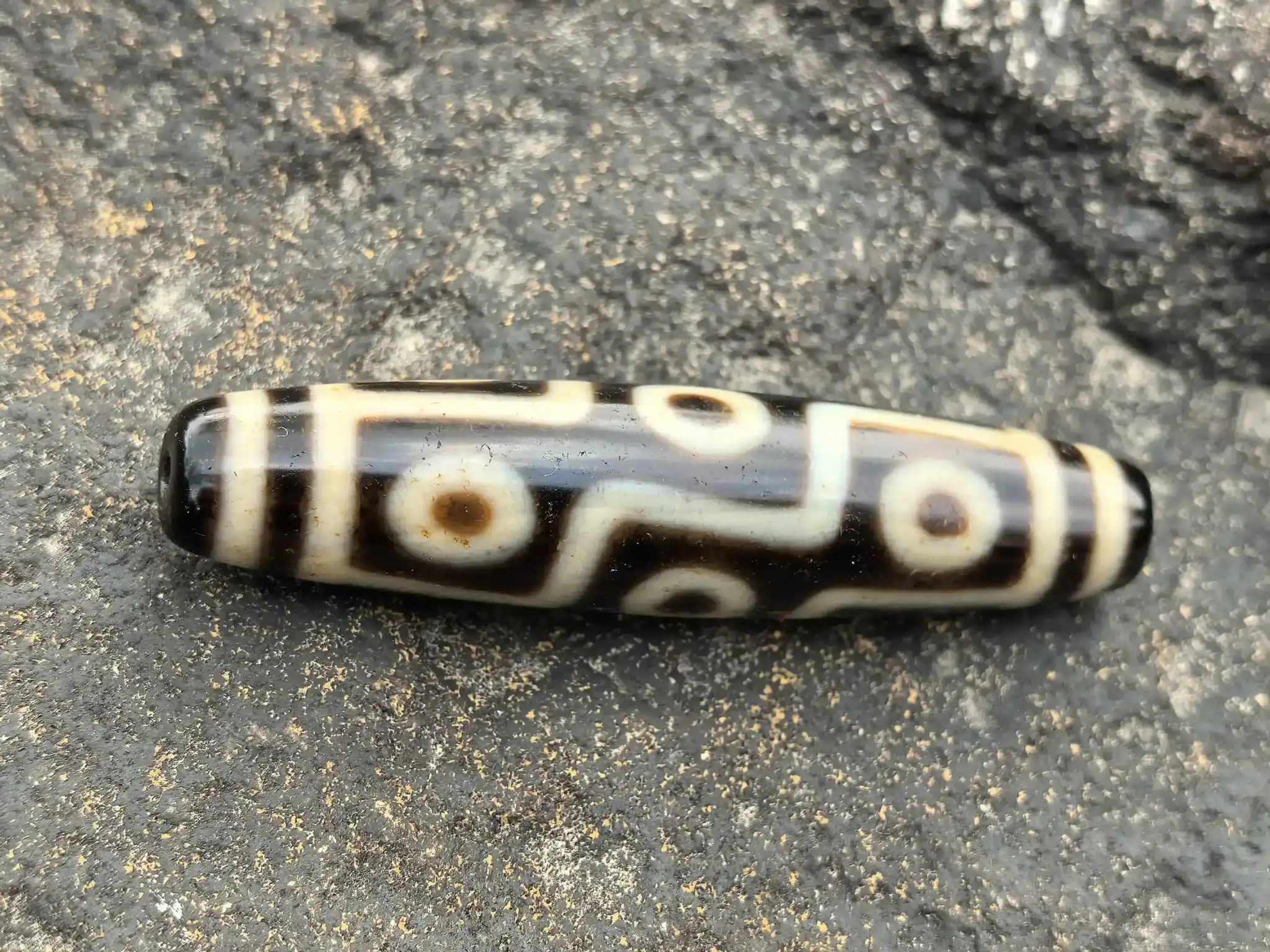
Where the Eye-Number Meanings Come From
The eye motif is far older than Buddhism — circular eye symbols appear across the ancient world as protective talismans. In pre-Buddhist Tibet, the Bön tradition tied the round eye to the Sky Deity within its cosmology. Later, Tibetan Buddhism layered a numerical framework on top: three eyes for the three mysteries of body, speech, and mind; five for the Five Buddha Families; six for the Six Perfections.
So the meanings you see today are a layered cultural heritage, not a single inventor's code. For the full four-thousand-year story, start with our guide: What Is a Dzi Bead?
One Eye — Focus and Singular Purpose
Clarity, simplicity, undivided intention. The single eye reads as a point of stillness: one thing, held steadily. It is often chosen by people simplifying their path — concentrating on one goal, one practice, one change at a time.
Two Eyes — Balance and Partnership
Two eyes are traditionally read as balance: wisdom and compassion, or harmony between personal and professional life. The pattern is often chosen for partnerships — romantic, business, or the reconciliation of two sides of oneself.
Three Eyes — Harmony of Body, Speech, and Mind
One of the most revered patterns. In Buddhist tradition, the three eyes correspond to the three mysteries: body, speech, and mind. The bead is associated with abundance, wellness, and peace — three aspects of a life aligned rather than scattered. For many wearers, a three-eye bead is the natural first Dzi.
Five Eyes — The Five Buddha Families
Less common in today's market. In the Vajrayana framework, five eyes correspond to the Five Buddha Families, each an expression of a different quality of awakened energy. Traditionally, the pattern is read as all-around balance — completeness across every direction.
Six Eyes — The Six Perfections
Six eyes map to the six paramitas: generosity, ethics, patience, diligence, concentration, and wisdom. The bead is associated with steady progress through difficulty — not removing the challenge, but outlasting it. You will often see six eyes paired with the vajra (diamond scepter) motif, a symbol of unshakable strength; the two reinforce each other.
Nine Eyes — The "King of Dzi Beads"
The most famous pattern of all. Nine eyes are associated with completeness, wisdom, and the clearing of obstacles, and linked in tradition to the nine levels of Buddhist teachings. A nine-eye bead is often chosen to mark a major undertaking — a new business, a big move, a long commitment.
Twenty-One Eyes — The Highest Aspiration
The rarest pattern you are likely to encounter. Twenty-one eyes symbolize universal compassion and the clearing of all karmic obstacles — the highest level of spiritual aspiration in the traditional system, and treated with particular reverence.
The Modern Shorthand: One Word per Eye
Walk into a crystal shop today — online or in Lhasa — and you will hear the eyes read in single words: three eyes for wealth, nine eyes for power. This is the newest layer of the tradition: a modern, market-friendly shorthand that compresses the older symbolism into one-word labels. Neither layer is "wrong" — they answer the same instinct at different depths. Here is the shorthand as it is commonly used today:
- 1 Eye — Wisdom
- 2 Eyes — Relationship
- 3 Eyes — Wealth
- 4 Eyes — Peace
- 5 Eyes — Blessings
- 6 Eyes — Success
- 7 Eyes — Good Luck
- 8 Eyes — Opportunity
- 9 Eyes — Power
- 10 Eyes — Virtue
- 11 Eyes — Harmony
- 12 Eyes — Fulfillment
- 13 Eyes — Transcendence
- 15 Eyes — Health
- 18 Eyes — No Obstacles
- 21 Eyes — Blessings
Beyond eye counts, a few classic motif beads have their own shorthand: Dragon Eye — Happiness; Heaven & Earth — Balance; Turtle Shell — Longevity; Feng Shui Bead — Positive Energy.
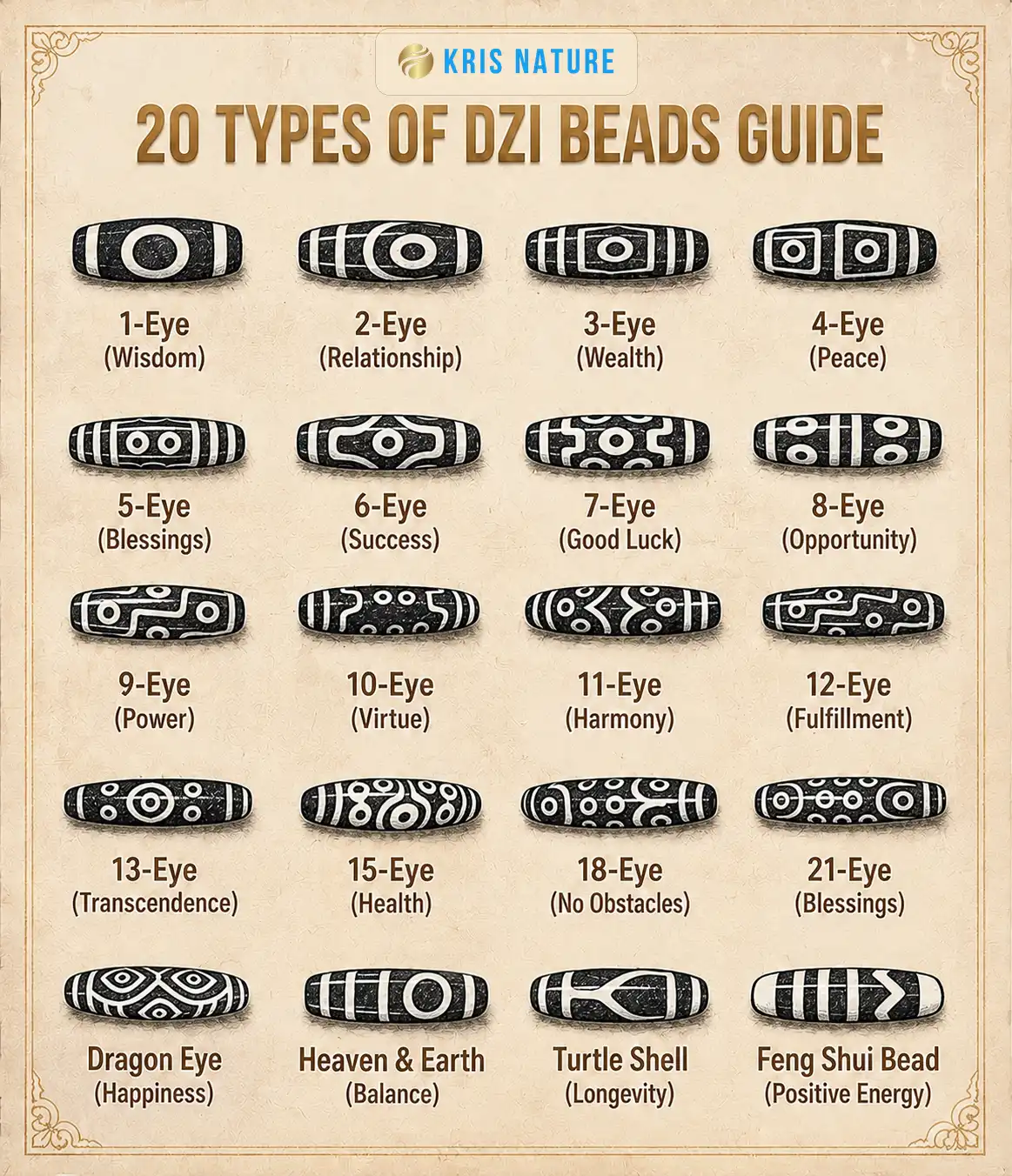
Notice how the two layers rhyme: "wealth" is the market's one-word compression of the three-eye ideal — body, speech, and mind in harmony, producing abundance. "Power" is the short version of the nine-eye ideal — completeness, and obstacles cleared. Same instinct, different depth.
More Eyes Does Not Mean a Better Bead
Eye number shapes meaning, not quality. A well-crafted three-eye bead is worth more — in every sense — than a careless nine-eye. When you shop, weigh the craft, the material, and the honesty of the description first; let the eye number answer the question of meaning, not price.
Crafted Eyes vs. Natural Eye Patterns
One distinction worth knowing: Dzi eyes are drawn and fixed by hand through an ancient etching process — they are intentional, crafted symbols. The "eyes" in natural eye agate (like silk agate) are formed by geology over millions of years. Different origins, different traditions, both worth understanding. We explain the natural kind here: Silk Agate Eye Patterns and Their Meanings.
How to Choose by Intention
- Clarity and focus: one eye or three eyes
- Partnership and balance: two eyes
- Steady strength through a hard season: six eyes, especially with a vajra motif
- A major new undertaking: nine eyes
Meaning is the start; material and craft are the rest. For the full walkthrough — bead types, honest pricing, what to ask a seller — see our Dzi Bead Buying Guide.
FAQ
Which eye number should I start with?
Three eyes is the classic first bead — balanced and broadly meaningful. But there is no wrong answer: choose the meaning you actually want to carry every day.
Is a higher eye number more powerful?
No tradition ranks wearers by eye count. Nine and twenty-one are rarer and more revered, but "powerful" is the wrong frame — these are symbols, not batteries.
Why do different sellers give different meanings for the same eye count?
Because the meanings were built in layers — ancient protective symbol, Bön cosmology, Buddhist numerology, and today's one-word market shorthand. There is no single official list, and anyone claiming their version is the only correct one is overselling. Choose the reading that resonates with you; what deserves scrutiny is not which meaning a seller uses, but whether they are honest about the bead's material and craft.
Do I need to be Buddhist to wear Dzi?
No. The eye-number meanings are cultural heritage, open to anyone. Wear them with respect for their origins — that is all any tradition asks.
Do these meanings apply to natural eye agate?
Not formally. The eye-number system belongs to the crafted Dzi tradition. Natural eye patterns carry their own, older protective symbolism — related in spirit, different in origin.
The meanings described here are cultural and historical symbolism, not claims of effect. Dzi beads are cultural ornaments — their value lies in the stories they carry and the intention you bring to them.