
What Is a Dzi Bead? A Complete Guide to Tibetan-Style and Natural Dzi
Last updated: September 2026
A straightforward look at Dzi beads — their cultural roots, historical origins, symbolic meanings, and how to tell the difference between Tibetan-style crafted pieces and naturally formed stone.
The Origin: Where Do Dzi Beads Come From?
In Tibet, the bead was originally known as "Zee" (Dzi), meaning "dignified," "auspicious," or "supremely virtuous." The New Book of Tang records Tibetan women wearing braided hair adorned with Zee beads — these are the earliest documented references to what we now call Dzi. If you ask elders in Tibetan regions, they may tell you legends: Dzi beads are treasures left behind by the gods, cast to earth because of their imperfections. Or that Dzi were once crawling insects, petrified into stone beads when covered by a hat.
Academic research into Dzi beads began in the 1980s with the German scholar David E. Ebbinghaus, who conducted extensive surveys in Tibetan regions of India and Nepal. His conclusion was clear: Dzi beads are, fundamentally, etched agate beads — a type of decorated stone where patterns are drawn onto the surface of agate or chalcedony using alkaline dyes, then permanently fixed through heat treatment.
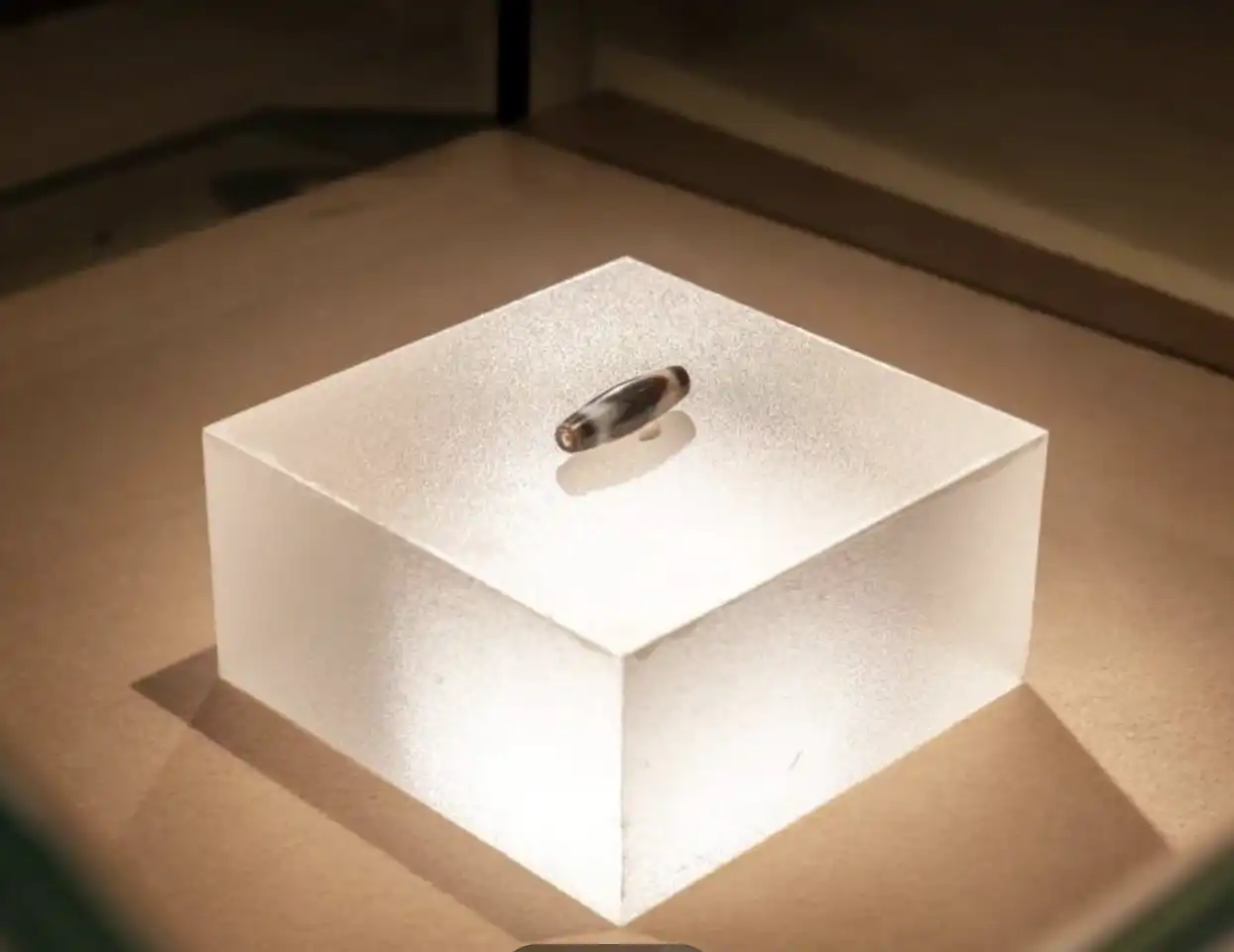
The technique is well over four thousand years old. The earliest documented examples are the etched carnelian beads of the Indus Valley, made by the Harappan civilization in the third millennium BCE and traded as far as Mesopotamia and Egypt long before they appear anywhere near the plateau. How the craft reached Tibet is not settled archaeology; Tibetan tradition ties these beads to the ancient Zhangzhung Kingdom — the powerful pre-Buddhist civilization that dominated western Tibet. What is documented is later: Dzi beads excavated in Tibet's Ali Prefecture date to approximately 1,800 years ago, the era in which Zhangzhung flourished — evidence that crafted agate beads were already circulating in the Tibetan cultural sphere by then.
The key point: Dzi beads are not divine relics fallen from the sky. They are ancient ornaments with identifiable, documented manufacturing techniques.
From Eye Worship to Sacred Symbol: How Dzi Patterns Evolved
The distinctive "eye" patterns on Dzi beads carry layered meaning accumulated over millennia. Their visual origins trace back to apotropaic eye traditions across ancient Eurasia — protective symbols far older than Buddhism — while their material form as crafted agate beads points to etching techniques arriving in the Zhangzhung cultural sphere from the Indus Valley by way of Central Asian trade networks. Understanding this evolution requires keeping two things separate: the ancient impulse to wear eye-shaped talismans, and the specific craft of etched agate beads that produced the Dzi tradition.
The Ancient Roots of Eye Symbolism
Since the Neolithic–Bronze Age transition, peoples across Mesopotamia, the Indus Valley, Egypt, and Central Asia developed protective eye traditions. Naturally banded or eye-patterned stones were ground into beads and worn as talismans to ward off the Evil Eye — a widespread ancient belief in a harmful gaze that brings misfortune. This practice of turning the threatening gaze back upon itself, using "eye against eye," reflects a shared human impulse long before any single religion codified the symbol. These early traditions were not "worship" of eyes in a devotional sense, but apotropaic — protective, defensive, and deeply practical.
The Zhangzhung Connection: Crafted Beads and Bön Symbolism
When agate bleaching and etching craft arrived in the Zhangzhung cultural sphere — likely transmitted through trade networks connecting the Indus Valley, Central Asia, and the Tibetan Plateau — local artisans adapted them to produce the beads that became central to Bön ritual. These were crafted objects, not naturally occurring stones. Archaeological evidence unearthed in Ali Prefecture indicates that Dzi beads circulating in the Zhangzhung civilization (circa 200 BCE to the 7th century CE) were already manufactured chalcedony Dzi. Within Bön cosmology, as recorded in texts such as the Tibetan Book of the Ten Thousand Nāgas, the circular eye motif was associated with the round sun symbol and the Sky Deity, while square or geometric patterns were linked to the Earth Deity. This thirteen-deity system gave the eye-and-square motifs a specific cosmological function: they were not merely decorative, but represented the interaction of celestial and terrestrial forces. It is worth distinguishing the manufactured ritual Dzi beads, known in ancient Tibetan as Sey, from naturally occurring eye-patterned shale stones occasionally venerated as minor talismans in folk practice. These are geologically and culturally distinct from manufactured Dzi beads. The Dzi tradition is, at its core, a craft tradition — a point established by Ebbinghaus's research and confirmed by archaeometric analysis of excavated beads.
Buddhism and the Numerical System: Eyes as Practice Stages
Buddhism first entered Tibet in the 7th century with the arrival of Śāntarakṣita and the establishment of early monastic centers. The systematization of Tibetan Vajrayana accelerated in the mid-8th century with the arrival of Padmasambhava (Guru Rinpoche) at the invitation of King Trisong Detsen. Padmasambhava is credited with consecrating and concealing Dzi beads as terma (hidden treasures) within the emerging Vajrayana framework, but he did not establish the numerical symbolic system linking eye counts to stages of spiritual practice. That framework — in which three eyes correspond to the three mysteries of body, speech, and mind; five eyes to the Five Buddha Families; and six eyes to the Six Perfections (paramitas) — developed within later Tibetan Buddhist tradition. It represents a secondary layer of meaning added to a bead form that already possessed deep Bön cosmological significance. The Bön-era Dzi bead carried sun-earth cosmological symbolism; the Buddhist-era Dzi bead acquired additional numerical stage symbolism. The two layers coexist, but they are historically sequential, not simultaneous.
The Complete Evolutionary Chain
The eye patterns on Dzi beads are therefore not arbitrarily invented. They represent a documented cultural evolution:
- 1. Near Eastern & Indus Valley apotropaic eye traditions — the protective impulse to wear eye-shaped talismans, transmitted across ancient trade routes.
- 2. Arrival of alkaline-etching craft in Zhangzhung — the technological transfer that allowed local artisans to manufacture etched agate beads, transforming the eye motif from a natural stone occurrence into a controlled cultural product.
- 3. Bön cosmological integration — the assignment of round-eye and square-pattern motifs to Sky and Earth deities within the thirteen-deity system, making the crafted bead a ritual object.
- 4. Tibetan Buddhist numerical overlay — the later addition of Vajrayana stage symbolism (three mysteries, five families, six perfections) onto an already symbolically charged bead form.
This cultural lineage is not a simple linear progression; it is a palimpsest — each historical layer adds new symbolic meaning without erasing older traditions. A three-eye Dzi bead worn today carries residues of Bronze Age protective magic, Zhangzhung Bön cosmology, and Buddhist Vajrayana pedagogy — all layered within a single crafted object.
How Dzi Beads Are Made: Understanding the Craft
The term "etched agate" describes the core technique. The most refined examples — known as "pure" Dzi — follow a five-step process:
- 1. Select a base stone — typically agate or chalcedony, chosen for density and workability.
- 2. Overall whitening — the stone is immersed in an alkaline solution, turning the entire surface white.
- 3. Draw the pattern — artisans apply a resist paste by hand to create the desired design on the white surface.
- 4. Dye and heat — the stone is soaked in an iron-based dye and heated; the areas not protected by the resist turn dark, while the resist-covered areas remain white.
- 5. Polish — the finished bead is ground and polished, revealing the sharp black-and-white contrast.
As this craft shows, dyeing and heating agate is one of the oldest accepted enhancements in jewelry — the problem was never the process, only sellers who hide it. Here is what is accepted and what is not. This ancient craft began to decline after the Tang Dynasty and was eventually lost for centuries. A related category known as Tsé Dzi employs a simplified process: lines are drawn directly onto natural agate, which is then darkened overall, resulting in patterns that lack the crisp black-and-white definition of pure Dzi beads.
Two Historical Craft Techniques: A Side-by-Side Comparison
| Category | Core Process | Internal Material | Historical Classification |
|---|---|---|---|
| Type I (Simplified / Tsé) | Lines are drawn directly onto the natural agate surface with a whitening agent, then fired once. The original stone color remains visible in the unpatterned areas. | The interior retains the natural color of the raw agate. | Tsé Dzi, etched line beads. Historically valued for cultural significance. |
| Type II (Full / Pure) | The entire bead is first whitened, then the pattern is drawn with resist paste, then the whole bead is darkened in a second firing. | The entire bead — both surface and interior — is transformed into a milky white layer. | Pure Dzi, the orthodox Tang Dynasty craft technique. |
What this means for understanding modern beads: Contemporary Tibetan-style beads that replicate the Type II process aim to recreate the fully transformed body — the whitened interior that gives the bead its distinctive depth and character. Beads made with a simplified Type I approach retain more of the original stone's natural appearance. Neither is inherently "better" — but knowing the difference helps you understand what you are looking at, whether it is an ancient bead in a museum or a contemporary piece crafted with revived techniques. When you hold a Dzi bead, you are holding an object from a technique family documented more than four millennia ago — and whose modern iterations are the result of careful revival, adaptation, and honest craftsmanship.
Cultural Significance in Tibetan Life: More Than a Bead
If you have visited Tibet, you know that Dzi beads are not museum pieces behind glass. In the Jokhang Temple in Lhasa, the crown adorning the 12-year-old Shakyamuni statue is inlaid with dozens of Dzi beads. This statue — originally part of Princess Wencheng's dowry when she married Songtsen Gampo in the Tang Dynasty — was later adorned with over one hundred Dzi beads, including three nine-eye beads, along with pearls, agate, turquoise, and coral. This is one of the most documented instances of Dzi beads used in Buddhist veneration, and the statue remains enshrined in the Jokhang's main hall today.

The sacred 12-year-old Shakyamuni Buddha statue in Jokhang Temple, heavily adorned with historic Dzi beads.
Walk through Lhasa, and you will see Dzi patterns incorporated into street lamps and public architecture. In monasteries across the region, Dzi beads appear on the foreheads and crowns of Buddha statues. For many Tibetan families, heirloom Dzi beads are passed down through generations — not commodities to be sold, but objects stored carefully at the bottom of a trunk, given to the eldest son, or included in a daughter's dowry. Ask about their origin, and the answer is often simply: "My grandmother wore it."
There is also a lesser-known dimension: in traditional Tibetan medicine, Dzi beads were occasionally used as ingredients. The Four Medical Tantras refer to "nine-eye stones" as a category of mineral or fossil with eye-like patterns, and certain precious Tibetan medicines — such as the renowned Seventy-Ingredient Pearl Pill — still include nine-eye stone in their formula. This is a historical practice, not a modern medical recommendation. Dzi beads are cultural ornaments, not medicinal substances.
The significance of Dzi beads for Tibetan people is not about whether they ward off evil. It is about their constant presence — from birth to marriage, from Buddha statues to street lamps, from medicine chests to family heirlooms. They are not miracles. They are part of life.
The Modern Dzi Market: Three Categories You Should Know
We cannot ignore the reality that Dzi beads are heavily marketed today. In the 1980s and 1990s, Taiwanese entrepreneurs recognized the commercial potential of Dzi beads and produced what collectors now call "old Taiwan beads" — pieces made with considerable skill that have, over decades, developed their own category within collecting circles. Today's market includes at least three distinct tiers:
- Pure Dzi — Genuine antiques, manufactured before the Tang Dynasty using the full alkaline etching and whitening process. Extremely rare, historically invaluable, and often found in museums or private collections. The original craft was lost for centuries.
- Tsé Dzi — Simplified technique, slightly later period, with patterns that are less crisply defined. Still historically significant, but distinct from pure Dzi in both method and appearance.
- Contemporary beads — Including modern reproductions, Taiwanese beads, and new crafted pieces made using revived traditional techniques. These are honest creations, not historical artifacts, but they carry the visual language and cultural resonance of ancient Dzi traditions.
These three categories are not mutually exclusive in value. Pure Dzi has its historical worth. Tsé Dzi carries its own legacy. Contemporary beads hold the craft of their own era. Together, they form the final chapter of a four-thousand-year story.
Understanding the Three Main Types of Dzi Beads Today
If you are searching for Dzi beads today, you will encounter three broad categories in contemporary jewelry. Knowing the difference helps you make an informed choice that aligns with your preferences and values.
| Type | How the Pattern Forms | How It Is Labeled at Glint & Grain | Explore |
|---|---|---|---|
| Tibetan-Style Dzi | Hand-drawn by artisans using revived etching techniques on natural agate | Traditional Craft — pattern is artisan-made, stated plainly | Tibetan Dzi collection |
| Silk Agate Dzi | 100% geological — natural banding formed underground over millennia | Natural • Untreated when verified untreated; any dyeing or heat treatment is stated on the product page | Silk Agate collection |
| Mongolian Dzi | Natural nine-eye shale — the eye patterns are geological; the bead shape is polished by hand | Natural Stone • Crafted Shape | Mongolian Dzi collection |
1. Tibetan-Style Dzi Beads (Crafted with Revived Traditional Techniques)
Tibetan-style Dzi beads are contemporary pieces made using methods that revive the ancient craft — but they are not ancient or naturally weathered stones. These beads are typically created from agate that has been shaped, treated with a patina, and etched using techniques similar to the historical process: whitening, hand-drawn resist patterning, alkaline dyeing, and controlled heating to create the distinctive black-and-white contrast and surface textures associated with antique Dzi beads.
- Stone base: Agate, selected for density and workability.
- Pattern creation: Hand-drawn by artisans using traditional resist techniques, then permanently embedded.
- Surface finish: Artisan-treated patina and hand-textured weathered surface.
- Result: Each bead carries subtle variations in line work, color depth, and texture.
2. Silk Agate Dzi Beads (Natural Stone with Natural Patterning)
Silk Agate Dzi beads are made from natural banded agate — a stone that forms over thousands of years beneath the earth's surface. The stone's name comes from its exceptionally fine, flowing layers that resemble silk fabric. These natural layers create concentric patterns that can evoke the eye-like designs traditionally associated with Dzi beads.
- Origin: Naturally occurring stone; the pattern is never applied by hand.
- Pattern source: The "eyes" and banding are formed by geological processes over millennia.
- Surface: Natural texture, polished but not artificially aged.
- Uniqueness: Each piece is truly one-of-a-kind, shaped by nature rather than human hand.
3. Mongolian Dzi (Natural Stone, Crafted Shape)
Mongolian Dzi beads are cut from nine-eye shale — a natural agate-rich rock found in the Inner Mongolian steppe region, whose orbicular "eye" patterns occur entirely within the stone. The bead shape is polished by hand, but the eyes themselves are geological. In other words: Tibetan-style Dzi carry a crafted pattern on natural stone, while Mongolian Dzi carry a natural pattern given a crafted shape. Neither is "fake" — but they are different categories with different value logic, and any honest seller will tell you which is which.
Dzi Bead Eye Numbers: What Do They Mean?
One of the most distinctive features of Dzi beads is the number of "eyes" — circular or oval patterns that appear on the stone's surface. In Himalayan cultural tradition, these eye numbers are associated with different symbolic meanings, rooted in the historical evolution from ancient eye worship to Buddhist numerical symbolism.
| Eye Count | Traditional Association | Often Chosen For |
|---|---|---|
| One Eye | Focus, clarity, singular purpose | Simplifying one's path; concentrating intention on a single goal |
| Two Eyes | Balance and harmony — wisdom and compassion, personal and professional life | Partnership, mutual understanding, relationships |
| Three Eyes | Harmony of body, speech, and mind — the three mysteries in Buddhist tradition | Abundance, wellness, and peace |
| Six Eyes | The six perfections (paramitas): generosity, ethics, patience, diligence, concentration, wisdom | Overcoming obstacles during challenging periods |
| Nine Eyes | Known as the "King of Dzi Beads" — completeness, wisdom, removal of obstacles; the nine levels of Buddhist teachings | Comprehensive support across all areas of life |
| Twenty-One Eyes | The most complex and rare pattern — universal compassion, clearing of all karmic obstacles | The highest level of spiritual aspiration |
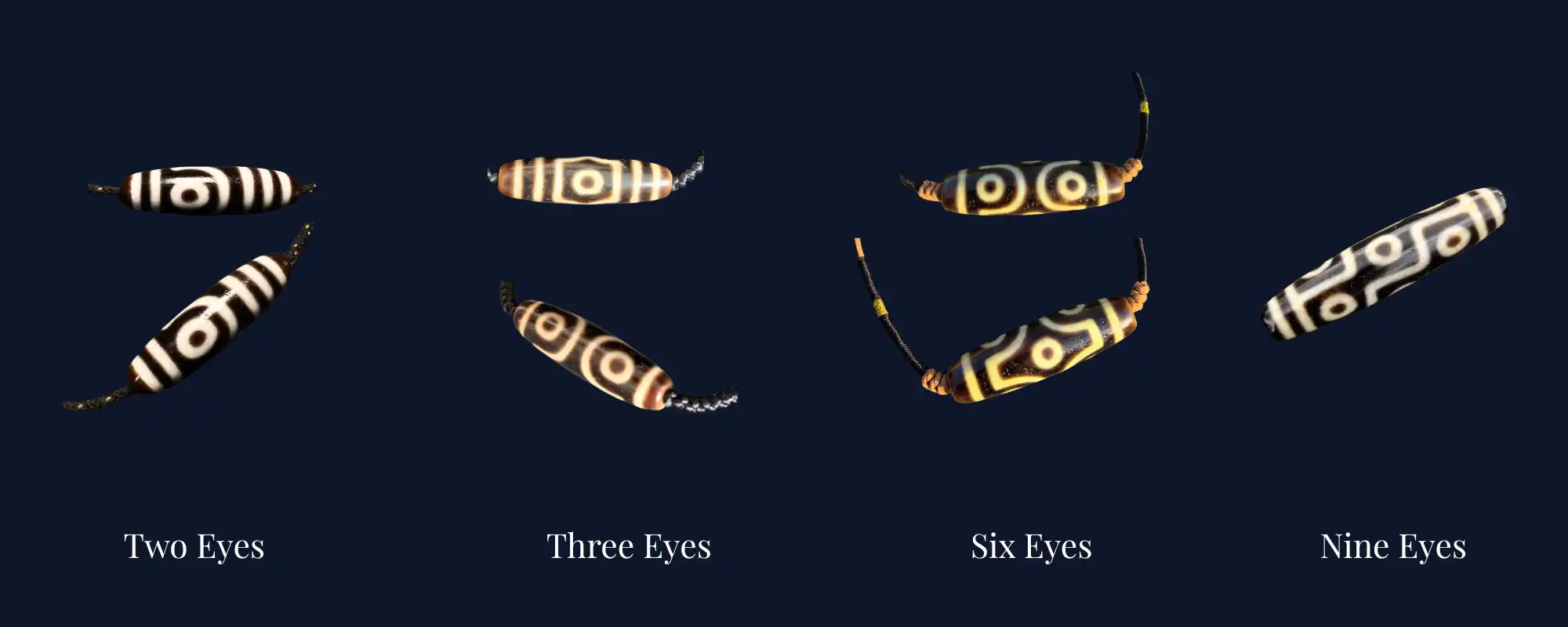
Visual breakdown of traditional crafted Tibetan Dzi bead eye patterns.
One Eye — Associated with focus, clarity, and singular purpose. Often chosen by those seeking to simplify their path and concentrate intention on a specific goal.
Two Eyes — Linked to balance and harmony, often interpreted as the balance between wisdom and compassion, or between personal and professional life. A symbol of partnership and mutual understanding.
Three Eyes — One of the most revered patterns. Associated with abundance, wellness, and peace — representing the harmony of body, mind, and spirit. In Buddhist tradition, the three eyes correspond to the three mysteries: body, speech, and mind.
Six Eyes — Associated with overcoming obstacles and embodying the six perfections (paramitas): generosity, ethics, patience, diligence, concentration, and wisdom. Often chosen as a symbolic companion during challenging periods.
Nine Eyes — Known as the "King of Dzi Beads." Represents completeness, wisdom, and the removal of obstacles. The nine eyes are associated with the nine levels of Buddhist teachings and the attainment of comprehensive understanding.
Twenty-One Eyes — The most complex and rare pattern. Associated with the highest level of spiritual aspiration — the embodiment of universal compassion and the clearing of all karmic obstacles. Highly valued in traditional contexts.
Important note: These meanings are rooted in cultural symbolism and traditional belief systems. They are not medical or scientific claims. Dzi beads are cultural ornaments — their value lies in the stories they carry, the intentions of those who wear them, and the thousands of years of cultural evolution they represent.
How to Choose a Dzi Bead by Intention
Selecting a Dzi bead is a personal process. Rather than focusing solely on appearance or price, many people choose based on the symbolic meaning that resonates with their current life circumstances or aspirations.
For Protection and Grounding
Consider beads with multiple eyes (six, nine, or twenty-one) or patterns associated with the vajra (diamond scepter) symbol. These are traditionally linked with stability, strength, and the clearing of obstacles.
For Clarity and Focus
A single-eye or three-eye bead may resonate with those seeking mental clarity, simplicity, and purposeful direction. The three-eye pattern is particularly associated with the harmony of mind, body, and spirit.
For New Beginnings
The Phoenix Eye pattern — resembling an eye within concentric circles — is associated with renewal, resilience, and transformation. It is often chosen during periods of change or personal growth.
For Mindful Daily Wear
Consider the practical aspects: cord comfort, bead weight, and adjustability. A lightweight choker with a sliding knot allows you to wear your Dzi bead throughout the day, from meditation practice to work and rest.
How to Wear and Care for Your Dzi Bead
Daily Wear
Dzi beads are designed to be worn close to the skin — as chokers, pendant necklaces, or bracelets. The cord is typically hand-braided for comfort and durability, with adjustable knots to fit different preferences.
- Avoid prolonged exposure to water, harsh chemicals, and direct sunlight.
- Store in a dry, cool place when not worn.
- The smooth surface can be gently wiped with a soft cloth.
- The cord may soften over time with wear — this is normal.
For the complete routine beyond these basics, see our guide: How to Care for Your Silk Agate & Tibetan Dzi.
Cultural Respect
When wearing Dzi beads, it is worth remembering their cultural origins. These are not merely fashion accessories — they carry centuries of Himalayan tradition, from the Bön religion's eye worship to Buddhist numerical symbolism, from the Zhangzhung Kingdom's trade routes to the crowns of Lhasa's temples. Wearing them with awareness of their symbolic context adds depth to the experience.
Frequently Asked Questions
Is a Dzi bead a natural stone or a crafted piece?
It depends on the type. Silk Agate Dzi beads are natural stone with naturally formed patterns. Tibetan-style Dzi beads are contemporary pieces crafted using revived traditional techniques — hand-drawn patterns etched into agate with artisan-treated surface finishes. Both are valid categories, but they differ in origin and production method. Ancient pure Dzi beads were also crafted pieces — etched agate, not naturally formed stones.
Are Dzi beads ancient or antique?
Most Dzi beads available today are not ancient. True antique Dzi beads — manufactured before the Tang Dynasty using the original full etching process — are extremely rare, often found in museums or private collections, and command very high prices. The beads sold by reputable contemporary makers — including Tibetan-style crafted beads and natural Silk Agate pieces — are modern creations that draw on traditional designs and revived techniques. The craft itself was lost for centuries and has only been partially reconstructed in recent decades.
Can Dzi beads heal or cure ailments?
No. Dzi beads are cultural ornaments, not medical devices. While historical Tibetan medicine texts mention the use of certain eye-patterned stones in traditional formulas, this is a historical practice, not a modern medical recommendation. They carry cultural significance and symbolic meaning, but they are not intended to diagnose, treat, cure, or prevent any disease. Any claims of healing or therapeutic effects should be viewed with skepticism.
How do I know if a Dzi bead is authentic?
The term "authentic" is often misused in the Dzi bead market. A more useful question is: What is this bead actually made of, and how was it produced? Reputable sellers will transparently describe whether their beads are natural stone (like Silk Agate), Tibetan-style crafted pieces using revived techniques, or antique beads with documented provenance. Look for clear descriptions of materials, techniques, and origins. The market has three tiers: ancient pure Dzi (extremely rare), Tsé Dzi (simplified historic technique), and contemporary crafted beads. For a step-by-step walkthrough, see our Dzi Bead Buying Guide.
What is the difference between Tibetan-style and natural Dzi beads?
Tibetan-style Dzi beads are contemporary pieces where the pattern is hand-drawn using resist techniques and the surface is artisan-treated to create a weathered appearance — reviving the ancient etched agate process. Natural Dzi beads (like Silk Agate) derive their patterns from geological processes — the stone itself formed these patterns over thousands of years. Both have cultural value, but their origins are fundamentally different. Ancient pure Dzi were also crafted, not natural — they were the product of sophisticated alkaline etching and heat treatment techniques that were lost for centuries.
What does the historical term "Zee" mean?
In Tibetan, the original name for these beads is "Zee", meaning "dignified," "auspicious," or "supremely virtuous." This term appears in early Chinese historical records, including the New Book of Tang, which describes Tibetan women wearing braided hair adorned with Zee beads. The term "Dzi" is a later Chinese designation that reflects the cultural reverence for these objects — but academically, they are classified as etched agate beads — a manufacturing tradition in a technique family documented for over four millennia (the earliest examples are etched carnelian beads from the Indus Valley), though how that craft reached Tibet is not settled.
Conclusion
Dzi beads occupy a unique space at the intersection of geology, craft, culture, and personal intention. They began as natural stones with eye-like patterns, revered by ancient peoples who saw in them the power of the benevolent gaze. They evolved into sacred symbols of the Zhangzhung Kingdom's Bön tradition, then into numerical maps of Buddhist practice. They adorned the crowns of Lhasa's greatest Buddha statues, traveled as dowry gifts between empires, sat in family trunks as inherited memory, and even found their way into traditional medicine cabinets. Today's market offers a spectrum: ancient pure Dzi beads that survive as museum pieces, historic Tsé beads that carry simplified legacy, and contemporary Tibetan-style beads that revive lost techniques with honest transparency. Alongside them, natural Silk Agate beads offer an alternative path — the quiet beauty of geological time, untouched by human etching. Whether you are drawn to the revived craftsmanship of Tibetan-style pieces, the organic beauty of naturally patterned Silk Agate, or the historical weight of ancient beads, the key is to choose with awareness — understanding what you are buying, why it matters to you, and how it fits into the broader four-thousand-year story of Himalayan cultural heritage.
At Glint & Grain by Kris Nature, we approach Dzi beads and agate jewelry with a simple commitment: say exactly what the material is, and let the story speak for itself. Agate has been worn for thousands of years across ritual, devotional, and daily-life traditions. Its density, smoothness, cool touch, and natural weight make it especially suited to quiet daily practice — not as a source of supernatural power, but as a tangible anchor for attention, intention, and steadiness. We describe our materials honestly: whether a piece is contemporary agate finished with revived Tibetan craft techniques, natural banded agate formed underground over thousands of years, or agate enhanced through accepted heat-treatment methods to bring out its color and character. When traditional craft or treatment is involved, we say so clearly. We respect the cultural lineage behind these symbols: Bön cosmology, Tibetan Buddhist numerical traditions, archaeological records, and the hands of artisans who still draw and finish each pattern one bead at a time. We do not promise miraculous healing, guaranteed fortune, or supernatural protection. We believe meaning is something you bring to the object — not something the object delivers by force.
For those who feel drawn to it, a Dzi bead or agate piece can become a quiet companion for daily practice: a grounding weight during a busy day, a symbolic reminder of protection and clarity, or a personal object of reflection. Glint & Grain offers these pieces with material honesty, cultural respect, and the hope that each one may support the right person in a meaningful way. Browse the collection.
Disclaimer: This article is intended for educational purposes. Dzi beads are cultural ornaments, not medical or therapeutic devices. Nothing here is intended to diagnose, treat, cure, or prevent any disease.