
Mongolian Dzi vs Tibetan Dzi: What's the Real Difference?
Quick Answer: The difference between Mongolian Dzi and Tibetan Dzi comes down to one question — where did the pattern come from? A Mongolian Dzi is a natural stone (banded agate or eye-patterned shale from the Gobi region) whose markings were formed by geology over millions of years; human hands shaped it into bead form — and where color has been deepened by traditional heat treatment, that is disclosed on the piece. A Tibetan Dzi is an agate bead whose pattern was drawn by artisans using an ancient alkaline-etching craft. One is nature's pattern in a crafted shape; the other is a crafted pattern on natural stone. This guide covers their origins, materials, cultural roots, an honest side-by-side comparison, and how to choose the right one for you.
The Two-Question Test: How to Tell Any Dzi Bead Apart in 10 Seconds
Before comparing origins, here is a simple framework you can apply to any Dzi bead you will ever encounter — in our shop, at a market, or in a museum. We call it The Two-Question Test:
- Question 1 — Who made the pattern? If the eyes and bands were formed underground by mineral layers, it belongs to the natural Dzi family (Mongolian Dzi, Silk Agate Dzi). If an artisan drew the pattern onto the stone, it belongs to the etched Dzi family (Tibetan-style Dzi — and, historically, every ancient pure Dzi as well).
- Question 2 — Who made the shape? Almost always, human hands. Even the most natural Dzi bead was cut and polished into its barrel or tube form. Shape is craft; pattern is the real dividing line.
Keep these two questions in mind. Every claim a seller makes — "natural," "antique," "Tibetan," "Mongolian" — becomes easy to verify once you ask them.
What Is a Tibetan Dzi? A Craft Tradition, Not a Stone
A Tibetan Dzi bead is an etched agate bead — and this is not a modern compromise, but the bead's original, documented identity. Academic research on Dzi beads began in the 1980s with the German scholar David E. Ebbinghaus, whose surveys across Tibetan communities in India and Nepal established that Dzi beads are decorated agate: patterns are drawn onto the stone with alkaline dyes and permanently fixed by heat treatment.
The craft of etching chalcedony is well over 4,000 years old. Its earliest documented examples are the etched carnelian beads of the Indus Valley, produced there in the third millennium BCE and traded as far as Mesopotamia and Egypt. How the technique reached the plateau is not settled archaeology; Tibetan tradition associates the beads with the ancient Zhangzhung Kingdom. What is documented is later: etched Dzi beads excavated in Tibet's Ali Prefecture date to roughly 1,800 years ago, in the era when Zhangzhung flourished. In Bön, the pre-Buddhist religion of Tibet, the round eye motif was associated with the Sky Deity and square patterns with the Earth Deity; later, Tibetan Buddhism layered a numerical symbolism onto the beads — three eyes for body, speech, and mind; nine eyes for completeness and wisdom.
The traditional "pure Dzi" process has five steps: select a dense agate base, whiten the entire surface in an alkaline solution, hand-draw the pattern with a resist paste, darken the bead with iron-based dye and heat, then polish to reveal the sharp black-and-white contrast. The original technique faded after the Tang Dynasty and was lost for centuries; today's Tibetan-style beads are made with revived traditional techniques — hand-drawn patterns, artisan-treated patina — as honest contemporary craft, not antiques.
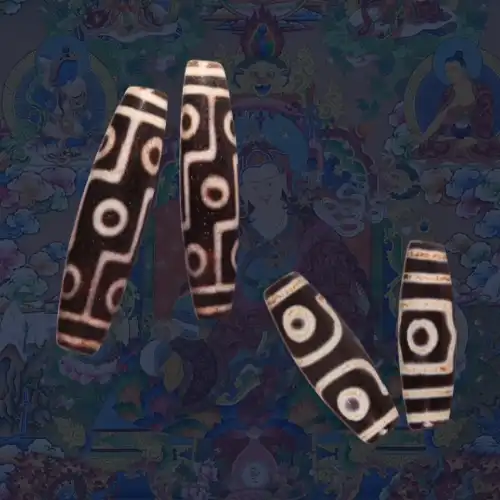
A Tibetan-style Dzi bead: natural agate base, hand-drawn etched pattern, artisan-treated surface.
For the full history — from Zhangzhung to the Jokhang Temple's Dzi-adorned Buddha statue — see our complete guide: What Is a Dzi Bead? A Complete Guide to Tibetan-Style and Natural Dzi.
What Is a Mongolian Dzi? Nature's Pattern, Human Shape
A Mongolian Dzi starts from the opposite direction: the pattern already exists inside the stone before any human touches it. The raw material comes from the Gobi regions of Mongolia and Inner Mongolia, including the Alashan (Alxa) desert — and it divides into two main families at Glint & Grain:
- Eye-stone (nine-eye shale). The classic 蒙天珠 material collectors call "nine-eye shale," a chalcedony-family stone in which iron and manganese tint concentric "eyes" and bands. The eyes are geological records — formed as silica-rich fluids filled ancient cavities layer by layer over millions of years.
- Alashan banded agate. A banded agate variety from the Alxa desert, valued for its flowing, water-like natural layers and warm, honey-toned palette — a more painterly, less eye-centered natural pattern. Chemically also a chalcedony-family stone (SiO₂, Mohs ~6.5 to 7), durable enough for daily wear.
In both families, the "eyes" and "flows" are geological. Cut across a stone's layers and polish the surface, and the concentric eyes, bands, or wave patterns appear — no artisan ever draws or etches the pattern onto the stone. What may be enhanced is color: some pieces are heat-treated or color-enriched to deepen reds and golds, and where that has been done, the piece says so openly. Two stones from the same deposit never produce the same pattern — which is why every natural Mongolian bead is genuinely one of a kind, and why no two Mongolian Dzi beads in any collection will ever match.
What human hands contribute is the shape: the rough stone is cut, ground into the classic Dzi barrel form, drilled, and polished. That is why an honest label for this family reads Natural Stone • Crafted Shape — the pattern is nature's work, the silhouette is the maker's. Color is part of the same label: a piece keeps the plain label only when its color is as-found; if color was deepened, the label adds “color enhanced” or “heat-treated” openly.

A Mongolian Dzi bead: the concentric eye formed underground; only the barrel shape was crafted.

Honey-toned banded agate from the Alashan Gobi — flowing natural layers, polished into the classic Dzi silhouette.
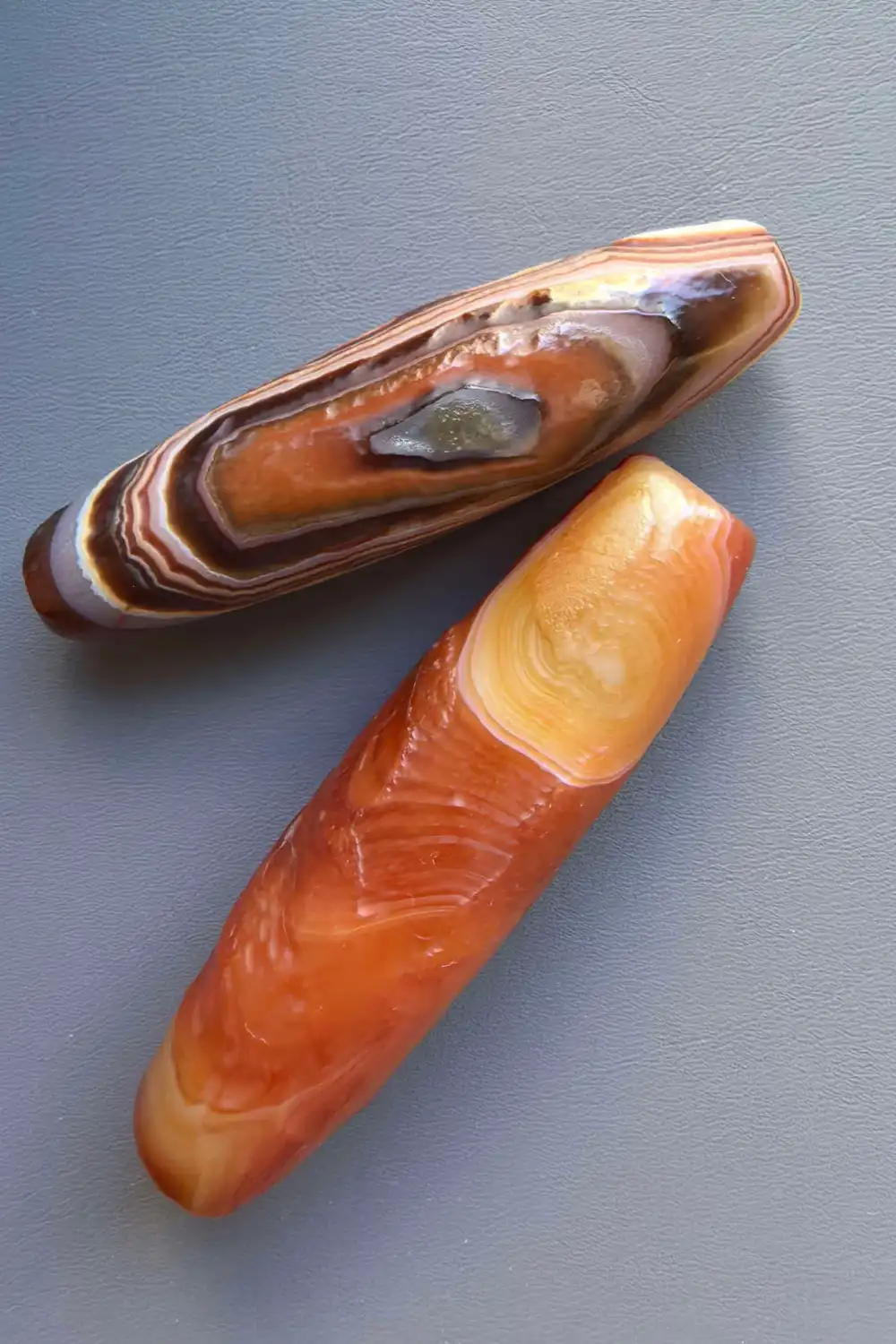
A pair of Alxa banded agate eye patterns in natural, as-found color — no heat treatment, no color enhancement.
To see this family in a finished piece, meet our Natural Two-Eye Mongolian Eye-Stone Pendant — a lance-shaped lezi cut from the classic eye-stone (nine-eye shale) material, with two complete concentric eyes in ochre-gold, rust-red, and deep black banding. It is a compact, everyday-wearable example of a Mongolian bead whose eye pattern was written entirely by geology — with the treatment status of each piece stated openly on its page.
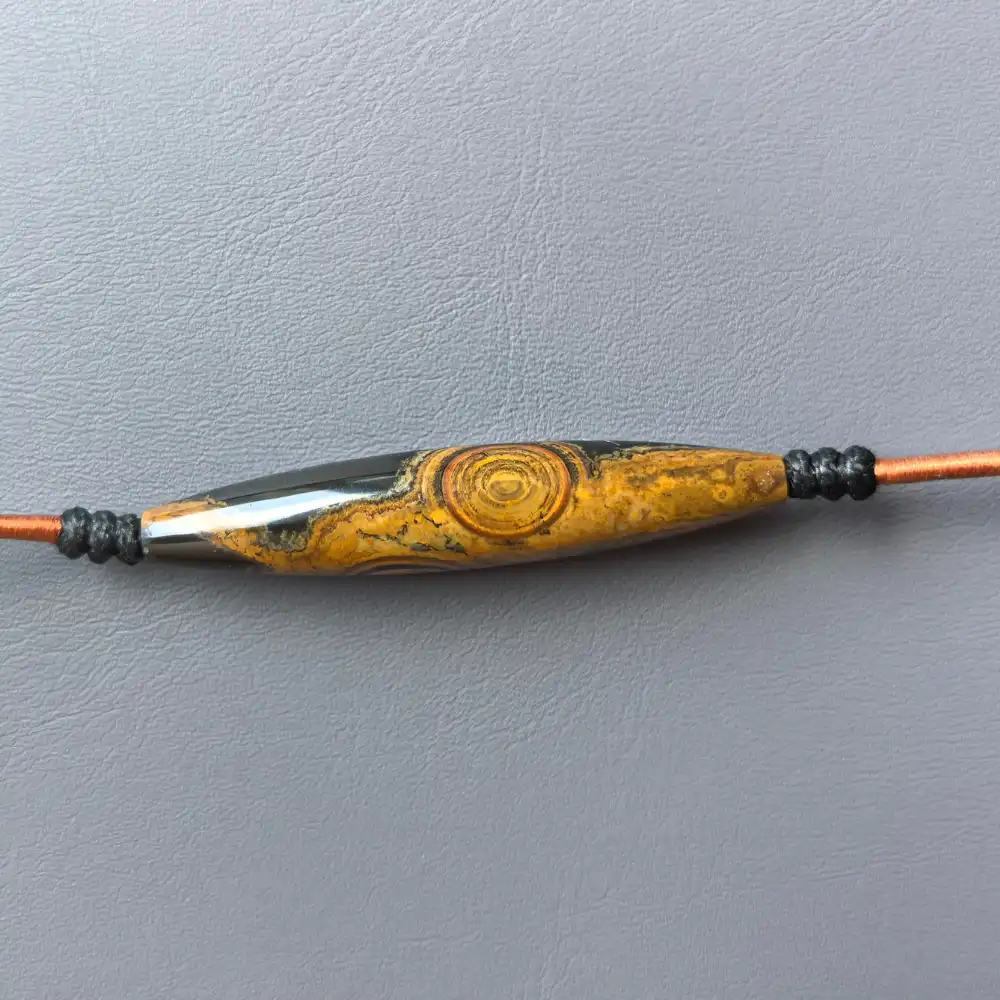
The finished piece: a two-eye Mongolian eye-stone (nine-eye shale, 蒙天珠) lance pendant in natural as-found color.
What Can Be Certified — and What Cannot
Since 6 June 2026, natural Mongolian Dzi has a published standard behind it in China. The Inner Mongolia Gem and Jewelry Industry Association issued the group standard T/GAIM 001-2026, Classification and Appraisal of Mongolian Dzi, and it is published on China's National Group Standards Information Platform, where the full text can be read. It covers both rough material and finished beads. It defines the stone — a naturally occurring, chalcedony-dominant cryptocrystalline aggregate with eye-like patterns, produced in Inner Mongolia, with Siziwang Banner in Ulanqab named as a representative source — references the national gemstone standards GB/T 16553 for appraisal and GB/T 16552 for naming, and classifies pieces by form, shape and pattern. That is a real step forward for buyers: whether a piece is genuinely this material, and what it should be called, is now something a laboratory can settle against a published standard.
What the standard deliberately does not include is any dating clause. It answers what is this stone, and what is it called — not how old is this bead. For the age of etched Tibetan-style Dzi there is no national, industry or group standard, and we looked. So the honest summary for any buyer is short: material can be certified, age cannot. A report can tell you what a stone is; only surface features and expert judgement can speak to how old it is, and that judgement stays contested even among specialists. It is also why we label by material and craft — Traditional Craft for hand-etched Tibetan-style pieces, Natural Stone • Crafted Shape for natural Mongolian ones — rather than by era.
Mongolian Dzi vs Tibetan Dzi: Side-by-Side Comparison
| Dimension | Mongolian Dzi (Natural) | Tibetan-Style Dzi (Crafted) |
|---|---|---|
| Pattern origin | Formed by geological processes over millions of years | Hand-drawn by artisans, fixed by alkaline dye and heat |
| Base material | Two natural families from the Gobi: eye-stone (nine-eye shale) and Alashan banded agate | Natural agate, selected for density and workability |
| Shape | Crafted — cut and polished into Dzi form | Crafted — shaped, etched, and finished by hand |
| Pattern look | Organic, flowing, soft-edged eyes and bands; warm earth tones | Crisp, high-contrast black-and-white geometry |
| Repeatability | Zero — every piece is one of a kind | Motifs repeat (eye counts, tiger-tooth stripes), each bead still slightly unique |
| Cultural root | Steppe and folk talisman traditions; natural "celestial-eye" stones | Bön cosmology and Tibetan Buddhist numerical symbolism |
| Honest label | Natural Stone • Crafted Shape — any color enhancement disclosed | Traditional Craft |
| Price tier | Premium — driven by the rarity of the raw pattern | Two worlds: new Dzi (modern Tibetan-style) is accessible — priced by artisan technique and labor, not rare material; genuine antique Dzi is extremely expensive, and most “ancient” beads on the open market are modern imitations |
| Best for | Wearers who want a one-of-a-kind natural stone | Wearers who want classic iconography and traditional symbolism |
What Neither of Them Is: Four Myths Worth Correcting
- Mongolian Dzi is not an ancient Tibetan antique. It is a natural stone finished today. Genuine pre-Tang antique Dzi beads are museum-grade rarities; anyone selling "ancient Dzi" at ordinary prices should be asked very hard questions.
- Tibetan-style Dzi is not "fake." Etched agate is the original, archaeologically confirmed Dzi technology — the ancient pure Dzi were crafted the same way. A modern etched bead works in the same technique family as the etched carnelian beads of the Indus Valley, made more than four thousand years ago: alkali etching, fixed by heat, applied to chalcedony. What is documented is the technique and its antiquity; how it reached the Tibetan plateau is not settled by archaeology. The problem was never the craft; it is sellers who hide it.
- "Natural" does not mean "untouched." Every wearable Dzi bead — Mongolian included — was cut, shaped, drilled, and polished. Nature made the pattern; people made the bead.
- Neither type guarantees fortune, protection, or healing. In Himalayan tradition these beads carry symbolic meaning — focus, balance, completeness — but symbolism is something you bring to the object, not something the object delivers by force.
How to Choose: Which One Is Right for You?
Choose a Mongolian Dzi if you want a natural Mongolian bead that no one else on earth owns. Its pattern was written by geology, so your bead is a singular piece — ideal if you value natural material, organic aesthetics, and the quiet weight of something formed long before human history. Explore our Mongolian Dzi collection.
Choose a Tibetan-style Dzi if you are drawn to the classic iconography — a specific number of eyes, tiger-tooth stripes, the crisp black-and-white language of Himalayan tradition — at an accessible price, made by artisans reviving a documented craft. Start with our guide to what each number of eyes symbolizes, then browse the Tibetan Dzi collection.
Consider a middle path — Silk Agate Dzi — if you want a natural pattern with a softer, more luminous look. Silk Agate is natural banded agate whose fine, silk-like layers form gentle eyes and flows; pieces verified as fully natural are labeled honestly as such, and any dyed or heat-treated piece says so openly on its page. See the Silk Agate collection and our Silk Agate complete guide.
Still deciding? Our Dzi Bead Buying Guide walks through the process step by step.
How We Label Them at Glint & Grain
At Glint & Grain by Kris Nature, every Dzi bead in the shop carries one honest label, because we believe the difference described in this article should never be hidden in fine print:
Mongolian Dzi — Natural Stone • Crafted Shape: the pattern is geology; the shape is ours; color is disclosed piece by piece (as found, or heat/color enhanced). Tibetan-Style Dzi — Traditional Craft: hand-drawn etched patterns on natural agate, made with revived techniques, never sold as antique or "naturally patterned." Silk Agate — labeled by its actual treatment, piece by piece.
One honest label for every material. That is the whole system — and it is all any buyer should need to ask for, from us or from anyone else.
Frequently Asked Questions
Is Mongolian Dzi a real Dzi bead?
Yes — with one honest clarification. "Dzi" describes a bead form and cultural family, not a single manufacturing method. A Mongolian Dzi is a genuine Dzi-form bead whose pattern is natural rather than etched. Historically, even the ancient Tibetan pure Dzi were crafted (etched agate), so "crafted" versus "natural pattern" is a materials distinction, not an authenticity verdict.
Is Tibetan Dzi natural stone?
The base material is natural agate, but the pattern is not natural — it is hand-drawn by artisans using an alkaline-etching process and fixed with heat. The technique is ancient — the earliest etched chalcedony beads date to the third millennium BCE — and archaeological and archaeometric research confirms that ancient Dzi beads were manufactured, not found with their patterns in place.
Which is more valuable, Mongolian or Tibetan Dzi?
They are priced by different things. Mongolian Dzi value is driven by the rarity and beauty of the natural pattern — a strong, well-formed natural eye in good material commands a premium. Tibetan-style Dzi value is driven by artisan labor and pattern precision; it is generally the more accessible entry point. Neither category should be confused with genuine pre-Tang antique Dzi, which are museum-grade and priced accordingly.
How can I tell Mongolian Dzi and Tibetan Dzi apart at a glance?
Look at the edges of the pattern. Natural patterns (Mongolian Dzi, Silk Agate) have soft, flowing transitions — the colors blend like watercolor because mineral layers deposited gradually. Etched patterns (Tibetan-style Dzi) have crisp, deliberate boundaries with sharp black-and-white contrast, because the design was drawn by hand. Soft edges point to nature; sharp geometry points to craft.
How can you tell if a Dzi bead is real?
Start by asking “real what?” — antique, crafted, or natural-patterned. Genuine pre-Tang antique Dzi are museum-grade rarities and almost never appear in ordinary shops, so any “ancient Dzi” at everyday prices is a red flag. For modern beads, the pattern tells you the family: natural patterns (Mongolian eye-stone, Silk Agate) have soft, flowing edges where mineral layers blended over millions of years, while crafted Tibetan-style patterns show crisp, deliberate lines drawn in fixed, inherited motifs — the classic eye counts, tiger-tooth stripes, and protective symbols of the tradition. Imitations in resin or glass feel lighter and warmer than stone. Above all, a real Dzi comes with an honest label — the seller states plainly whether the pattern is geological or hand-etched, and discloses any treatment. No label, no clear answer: walk away.
Can a Mongolian Dzi have nine eyes?
Yes — naturally occurring multi-eye patterns exist in nine-eye shale and banded agate, and they are the most sought-after pieces in this family. The difference from an etched nine-eye Tibetan bead is that no artisan placed those eyes; the stone formed them. Natural nine-eye material is genuinely rare, which is reflected in its price.
Is a Mongolian bead the same as a Mongolian Dzi?
Yes. “Mongolian bead” and “Mongolian Dzi” both refer to the natural Dzi family from the Gobi — eye-stone (nine-eye shale) and Alashan banded agate. The bead is the object; “Dzi” is the traditional name for the bead form it is shaped into. Either way, the pattern is geology’s work, not an artisan’s.
Is the color of Mongolian eye-stone natural?
The eye pattern is always natural — that is the defining feature of this family. Color is a separate question: some pieces are worn and polished with their color as found, while others are heat-treated (roasted) or color-enriched by traditional methods to deepen reds and golds. At Glint & Grain, a piece labeled plain “Natural Stone • Crafted Shape” has as-found color; any heat or color treatment is disclosed on the product page. Pattern and color are two different questions — always ask for the label.
Is there a standard for appraising a Mongolian Dzi?
Yes, for the material. In June 2026 the Inner Mongolia Gem and Jewelry Industry Association published the group standard T/GAIM 001-2026, Classification and Appraisal of Mongolian Dzi, covering raw and finished pieces, with appraisal referencing GB/T 16553 and naming referencing GB/T 16552. It covers material and classification only: it contains no dating clause, and no standard of any kind currently covers the age of etched craft Dzi.
Do Mongolian or Tibetan Dzi beads have healing powers?
No. Dzi beads are cultural ornaments, not medical or therapeutic devices, and no type of Dzi bead can treat, cure, or prevent any condition. Their meanings — focus, balance, protection, completeness — are symbolic frameworks from Himalayan tradition that wearers use for intention and reflection. Any seller claiming guaranteed effects should be viewed with skepticism.
Explore the Dzi Collections
Whether you choose nature's pattern or the artisan's line, choose it with open eyes. Browse our Mongolian Dzi, Tibetan Dzi, and Silk Agate collections — every piece labeled for exactly what it is.
Disclaimer
The meanings of Dzi beads described in this article are symbolic and cultural. They are not medical claims or guaranteed effects. Instead, they offer a way to connect with natural stone and Himalayan craft tradition through intention, beauty, and personal reflection. Dzi beads are cultural ornaments and are not intended to diagnose, treat, cure, or prevent any disease.