
Four Seasons Phantom Quartz: What the Layers Inside the Stone Really Are
Quick Answer: A phantom quartz is not a separate mineral species. It is ordinary quartz that stopped growing, gathered a fine dusting of other minerals on its faces, and then started growing again — sealing that dusting inside the crystal. What you see through the polished surface is a ghost: the outline of an earlier crystal, frozen at the moment it paused. In the Chinese crystal trade, beads whose layers show several distinct colour bands are sold as “four seasons phantom” — green for spring growth, red for summer heat, gold for the harvest, white for stillness. Nothing is painted or inserted afterwards; the layers sit on the crystal's own growth planes. That is why they cannot be polished off — and why no two beads are ever the same.
What a Phantom Actually Is: a Pause, Recorded
Quartz grows out of silica-rich fluid, atom by atom, building the same repeating structure in every direction. When the supply of silica slows — because the pocket cools, or the fluid chemistry shifts — the crystal simply stops extending. During that pause, whatever else is suspended in the fluid settles onto the crystal's faces: fine chlorite particles, iron oxides, clay minerals, tiny flakes of mica.
Then conditions change again. Silica-rich fluid returns, and the crystal keeps growing — over the dusting, sealing it inside. The layer of "dirt" becomes an internal surface: a boundary with older crystal below it and newer crystal above it. That boundary is the phantom line. What you are looking at is not an inclusion floating in a stone; it is the record of the shape the crystal had before it paused.
If the pocket paused once, you get one phantom. If it paused repeatedly — which is common in vug quartz — you get nested outlines, one inside the next, like the rings of a tree. Sellers call those layered stones “thousand layer” quartz, and the pieces with a distinct colour change at every pause are the ones sold as “four seasons phantom.”
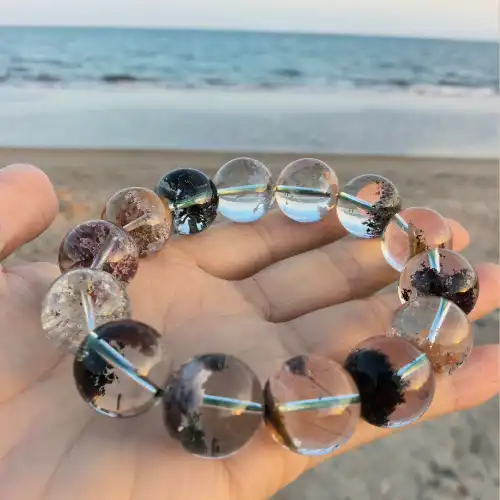
Four seasons phantom quartz in the hand: dark green and rust layers sealed inside clear beads, each one different.
Why Some Phantoms Are Green, Some Red, Some White
The colour is the colour of whatever settled during the pause — it is not a property of the quartz itself. Quartz is colourless in its pure form; the tint you see inside a phantom comes from the mineral dust trapped on that old surface.
- Green. Chlorite — the soft, green, mica-family mineral that also tints many alpine quartz specimens — produces the classic green phantom. It is the most common colour in the market by a wide margin.
- Red, rust and copper. Iron oxides and fine hematite dusting produce reds and rusty browns. In beads these usually read as a warm brick or copper tone rather than a bright red.
- White, grey and gold. Clay minerals and pale mica give white or grey phantoms; mixtures of iron and clay give the yellow-gold tones sellers call “yellow phantom.”
In practice the dusting is never pure, which is why one bead can read green in one layer and reddish in the next. That mixture is also what makes a strongly banded bead look like a landscape.
The Names You Will See — and What They Describe
These are trade names: a shared shorthand among crystal sellers for what a piece looks like. They describe appearance, not geology, and different sellers apply them loosely. Here is what each one is pointing at.
| Name | What it describes | What to look at |
|---|---|---|
| Phantom quartz | Any quartz with a sealed inner growth stage — the umbrella term | Is there a defined boundary inside, or just a cloudy patch? |
| Green phantom | Green chlorite layers — the standard, most available type | Is the green sitting in flat internal layers, or smeared through cracks? |
| Red phantom | Iron-oxide layers; usually a copper-red or rust tone | Red-brown, evenly layered — a bright candy red usually points elsewhere |
| Four seasons phantom | One bead with several clearly different colour layers — read as seasons: green for spring growth, red for summer heat, gold for autumn harvest, white for winter stillness. The name describes the palette, not a claim about what happened in the pocket | Do the colours sit in separate layers, or is one colour dominant with coloured reflections? |
| Many-layer phantom (“thousand layer”) | Repeated growth pauses: nested ghosts, often dozens of thin bands | Count the bands; dense, fine, evenly spaced layers |
| “Treasure bowl” / half-bowl | Inclusions heaped at one end of the bead, leaving the other end clear — “half-bowl” means the heap fills about half | The name describes the shape of the heap. It is not a promise of anything. |
| Moss / water-grass phantom | Feathery, branching growth instead of flat layers | Branch structure with depth — grass-like, not painted flat |
Three Things Sold as "Phantom" That Are Not
- Dyed quartz. The most common lookalike. Dye travels along cracks and grain boundaries, so the colour looks like veins, is strongest near the drill hole, and reads flat rather than layered. A real phantom's colour lives inside a planar layer, with clear quartz both above and below it. Our guide to how to tell if agate is dyed walks through the same checks on banded material.
- Glass or resin with added inclusions. Inclusions in glass look like glitter or foil flakes; the body usually shows round air bubbles, and the surface has no growth planes at all. Inclusions in quartz have depth and sit on internal surfaces, not suspended at random.
- Surface treatments. Occasionally a colour is only on the outside — a coating or a dyed polish. Look at the drill hole and the edge of the bead under a lamp: a surface colour shows up as a rim, while an internal phantom disappears where the bead curves away.
The Four Checks You Can Do in Ten Seconds
Hold the bead up to a window or a phone light. In order:
- 1. Depth. You should be looking through clear quartz at the layer — there is crystal in front of it and crystal behind it.
- 2. Boundary. A phantom has an edge, usually flat or gently curved, because it is the relic of a crystal face. A vague cloud with no edge is just an inclusion.
- 3. Independence. The layers ignore the shape of the bead. They were formed long before anyone cut it, so they should cross the bead at their own angle.
- 4. The hole. The drill hole is where imitations give themselves away: dye pools there, and glass chips conchoidally. In natural quartz you see translucent stone with no colour concentration.
Wear, Care, and What Actually Damages It
Quartz is a 7 on the Mohs hardness scale, and the phantom is sealed inside the stone rather than sitting on the surface — so the layers cannot rub off, fade from handling, or wash away. What actually damages these beads is impact: chipping at the edges, or a hard knock against a stone counter. Splitting a quartz bead takes force; scuffing one mostly takes carelessness with harder materials.
- Cleaning. Warm water, a drop of mild soap, a soft brush, then pat dry. No bleach, acetone, or abrasive pastes.
- Heat. Avoid sudden temperature changes — a hot car dashboard or a steamer. Thermal shock is what cracks quartz, not water.
- Ultrasonic and steam cleaners. Skip them on strung pieces: the stone is fine, but the cord and knots are not.
- Storage. Keep it from rubbing against harder stones or metal clasps; a pouch solves it.
For a full routine, see our guide to caring for natural stone jewellery and to cleaning your stone at home. If your phantom is strung on a hand-braided cord, the cord deserves as much attention as the beads — here is how our cords are made and why knots, not glue, hold them.
How These Beads Are Judged in the Market
Phantom quartz is not a rare mineral — quartz is one of the most common minerals on earth, and the interesting question is never "how scarce is the species" but "how legible is this particular record." In practice, this is what to look at:
- Legibility. Can you see the phantom from half a metre away, or only with a loupe?
- Contrast. A crisp boundary between inclusion and clear quartz — like the sharp line in a well-formed “treasure bowl” piece — is valued over a smudged one.
- Layer count and evenness. Nested, evenly spaced layers read as a picture; chaotic blotches do not.
- How much clear quartz is left. Clear space around the inclusion is what makes the ghost visible at all.
- Bead size. Larger beads mean larger rough, and larger rough with a clean phantom is scarcer. This is a market fact, not a geology one.
None of this is a measure of "power." It is the same logic as judging any natural material: how clearly, and how beautifully, did nature leave the mark.
Two Ways of Reading a Phantom
Phantom quartz tends to be loved for one of two reasons, and most people who fall for it end up holding both at once.
The story the stone carries
A phantom is a crystal that paused, gathered a dusting of mineral on its face, and then kept growing. Read as a life, that is unusually exact: interruption, settling, continuing anyway. The reading is not a modern invention, and nothing has to be added to the stone for it to be there — the internal structure already is the description. It is simply what the crystal looks like when you describe it in the language of a life rather than the language of mineralogy.
Colour gives that reading its vocabulary:
- Green — spring, new growth, beginning again.
- Red and rust — summer, heat, drive, passion.
- Gold and yellow — autumn, harvest, what has been gathered.
- White and grey — winter, stillness, clearing.
In the chakra vocabulary common in crystal culture, green is read as the heart centre and clear or white quartz as the crown; in the language of transitions, a phantom is read as a reminder that growth resumes after a pause. That is why the material sits well with people who are in the middle of a change — a move, a change of work, a year that took something away.
None of that is a claim we make about effects. It is the framework a wearer brings, and a stone can hold a symbol for someone without promising an outcome. What can honestly be said is that a phantom is a good object for a practice: it gives the eye somewhere to rest, and the layers keep unfolding the longer you look.
The picture inside
Some people come to this material with no interest in symbolism at all. They simply like looking into the stone, and phantom quartz rewards that more than almost anything else in the crystal world. In the English-speaking collector market it is usually called Garden Quartz — also Lodolite, Landscape Quartz, Inclusion Quartz — and the pleasure is purely visual: clear quartz acting as glass around a landscape that formed on its own.
What people who collect it look for:
- Transparency. The clearer the quartz around the inclusion, the more the internal scene reads. A phantom behind cloudy stone is a smudge; behind clear stone it is a picture.
- Depth and layers. One flat layer is a curiosity; nested layers with space between them read as distance — foreground, middle ground, horizon.
- Legible forms. Green chlorite layered like hills, branching growth that reads as trees, a colour change that reads as weather. Collectors call this a landscape or a garden, and they know it when they see it.
- Size without mud. A large bead with a clean scene inside is the scarce combination: the rough has to be big, and the internal picture has to be unobstructed.
At mineral shows and in specialist shops, that combination — clear body, layered internal scene, no visible damage — is where the price sits. It is a global standard: the same bead is described the same way in Tucson, Munich or Shanghai, because this appreciation does not lean on any tradition at all. A garden inside a stone is a garden inside a stone.
Most people who love phantom quartz end up on both sides of it: they came for the picture and stayed for the meaning, or the other way round. The stone does not have to choose between the two, and neither do you.
How We Label It at Glint & Grain
Phantom quartz sits on the natural side of our shop, and it carries the same label as the rest of our natural material:
Phantom Quartz — Natural Stone • Crafted Shape: the layers are geology, the bead is cut, drilled and polished by hand, and the colour is as-found — our phantom quartz is undyed and not heat-treated. If that ever changes for a specific piece, it will be stated on its product page rather than left for you to guess.
The point of the label is simple: you should never have to wonder whether you are looking at a growth record or a dye job. Pattern and colour are two separate questions, and both should have an answer.
Frequently Asked Questions
What does "four seasons phantom" mean?
It is a Chinese crystal-trade name, not a scientific one. It is used for phantom quartz beads whose inner layers show several clearly different colours — green, rust-red, gold, white, grey — read the way a year is read: green for spring and new growth, red for summer heat, gold for autumn harvest, white and grey for winter stillness. The "four seasons" describes the palette in one bead, like a landscape with several weathers in it. It is not a claim about what happened in the pocket while the crystal grew, and it is not a statement about the effect of wearing it.
Is four seasons phantom quartz the same as green phantom quartz?
Not exactly, and the difference matters when you are shopping. Green phantom is the common material: green chlorite layers in clear quartz. "Four seasons" is a step up in description — several distinct colour bands in one bead. Some sellers use the term loosely for any colourful phantom, so the honest test is on the bead itself: how many genuinely different colours can you see in separate layers? If the answer is one, it is a green phantom, whatever the listing calls it.
Is the green colour in phantom quartz natural?
Usually, yes — green in this material normally comes from chlorite that settled inside the crystal during a growth pause, and that colour is stable. But treated material exists in every corner of the crystal market, which is why the question should always be answered by the seller rather than assumed. Ask directly whether a bead has been dyed or heat-treated; if the answer is vague, look at the drill hole under a light, where dye shows first.
How can I tell a real phantom quartz bead from glass?
Four things, in order of speed. Air bubbles: glass almost always has a few round ones. Growth planes: quartz has internal structure, glass has none. Depth: a phantom sits on a surface inside the crystal, so there is clear stone in front of and behind it. And the boundary: a real phantom has a defined edge, usually planar, where the earlier crystal face used to be, while inclusions in glass tend to float with no geometry.
Does phantom quartz have metaphysical or healing properties?
Not as a matter of fact, and we do not sell it that way — though we understand why the question comes up, because this is one of the few stones whose internal structure matches the story people tell about it. What a phantom genuinely offers is a symbol with unusually clear shape: a pause, a layer of what settled during it, and growth that continued afterwards. That is the reason it is read in the language of seasons — green for new growth, red for heat and drive, gold for what has been gathered, white for stillness — and the reason it suits people in the middle of a change. A symbol a person chooses for herself is not the same thing as a promised effect, and no stone can treat, cure or prevent any condition. The trade names around this material describe what the layers look like: a “treasure bowl,” for instance, means inclusions heaped at one end of a bead like a pile in a bowl. It describes a shape.
Why is phantom quartz called Garden Quartz?
Garden Quartz — also sold as Lodolite, Landscape Quartz or Inclusion Quartz — is the collector-market name for quartz whose internal inclusions form a scene: green chlorite layered like hills, branching growth that reads as trees or moss, a colour change that reads as weather. It is the same material, approached from the other direction: the Chinese trade names the type, the English collector names the picture inside. If you are buying for the visual quality rather than the symbolism, that is the vocabulary to search with — and the same checks apply, because a landscape inside a stone cannot be manufactured, only found.
Will the layers wear off if I wear it every day?
No. The phantom is sealed inside the crystal, not applied to the surface, so handling, water and daily wear cannot remove it. What does affect these beads is impact — a chip at the edge from a hard knock — and heat, in the form of sudden temperature changes. Worn sensibly, a phantom quartz bead keeps its layers for as long as the stone exists.
Explore the Crystal Collection
Phantom quartz is the material we look at hardest when we buy: a stone that records its own history, with nothing added and nothing hidden. Browse the current pieces in the shop — every piece labelled for exactly what it is.
Disclaimer
The names and meanings discussed in this article are commercial and cultural. They are not medical or scientific claims, and no stone described here treats, cures, or prevents any condition. Phantom quartz is a natural material with a geological history; the names around it are a way of looking at that history, not a promise of effects.