
Three-Eyed Dzi Beads: What the Three Eyes Mean and How the Cord Is Made
The three-eye bead is the one most people meet first. It is not the rarest dzi pattern and not the most famous — that is the nine — but it is the one you will see most often worn: usually hung at the collarbone as a choker or necklace on a hand-knotted cord, occasionally set as the centre bead of a bracelet.
In Tibetan tradition the three eyes are read as the three mysteries: body, speech, and mind. A bead carrying them is associated with a life that is aligned rather than scattered. This guide covers what the pattern means, how crafted dzi eyes differ from the natural eyes inside silk agate, and how a hand-knotted cord piece is put together — knot by knot, by hand.
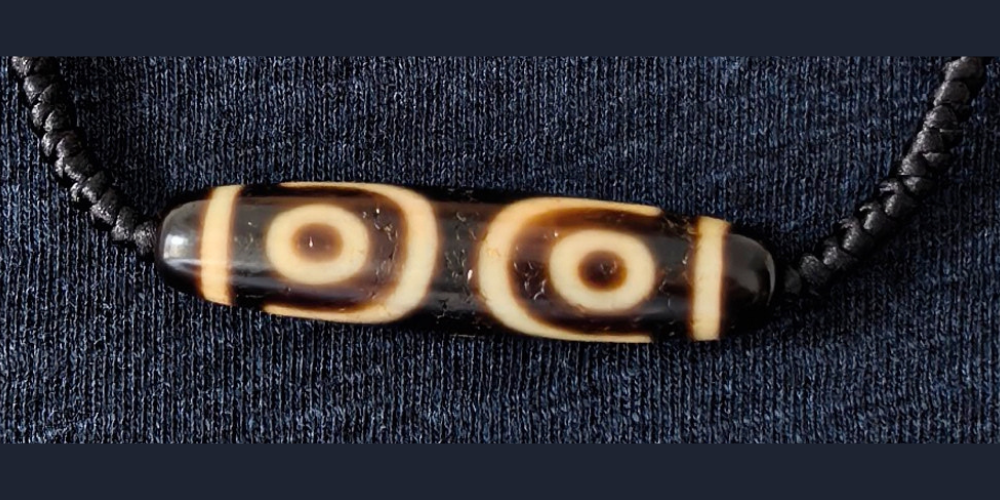
A three-eyed dzi bead on its cord. The eyes are worked into the surface treatment of the agate, not painted on top of it.
What Is a Three-Eyed Dzi Bead?
A dzi bead is an agate bead whose eye pattern is worked into the stone itself — etched and treated so that the motif reads as part of the material rather than sitting on top of it. A three-eyed dzi carries three circular eyes worked into the banding of the bead.
Two things are worth knowing before you shop. First, the pattern is deliberate: it is a crafted symbol, made on purpose, and the craft is what separates a good bead from a careless one. Second, the bead's eye count tells you about meaning, not quality. A well-made three-eye bead is worth more than a careless nine-eye bead, in every sense.
For the full background — where dzi beads come from and how the eye motif travelled across Asia long before Buddhism — start with our guide: What Is a Dzi Bead? A Complete Guide to Tibetan-Style and Natural Dzi.
What Do the Three Eyes Symbolize?
The traditional reading: body, speech, and mind
In Tibetan Buddhist tradition the three eyes correspond to the three mysteries — body, speech, and mind — the three doors through which a life is expressed. When the three are in harmony, tradition describes the result as abundance, wellness, and peace: three aspects of a life that is aligned rather than pulled in three directions at once.
That is why the three-eye pattern is often read as the pattern of a person setting something straight — getting their work, their words, and their body pointed the same way.
The modern shorthand: "three eyes for wealth"
Walk into any crystal shop today and you will hear eye numbers compressed into single words. In that shorthand, three eyes means wealth.
This is the newest layer of the tradition, and it is not a contradiction of the older one — it is the short version of it. Body, speech, and mind working in harmony is how abundance is traditionally described as arriving in the first place. The shop label compresses the idea; the tradition explains it.
For all the eye counts, traditional and modern, see our Dzi Bead Eye Meanings guide.
Where the eye motif itself comes from
The eye is far older than Buddhism. Circular eye symbols appear across the ancient world as protective marks, and in pre-Buddhist Tibet the round eye was tied to the Sky Deity in Bön cosmology. Tibetan Buddhism later layered its numerical framework on top: three eyes for body, speech, and mind, five for the Five Buddha Families, six for the Six Perfections.
Crafted Eyes and Natural Eyes Are Two Different Things
There is a distinction worth holding on to when you shop for anything with the word "eye" in it.
- Crafted eyes are drawn and fixed by hand on a dzi bead. They are intentional symbols, the product of an old etching process, and their count carries the meanings above.
- Natural eyes are geology. In silk agate — the banded agate of the Alashan Gobi — the "eye" forms when fine silica bands wrap around a centre point over millions of years. Nobody designed it. The pattern is simply what the stone did.
Different origins, different traditions, and both worth understanding. We explain the natural kind here: Silk Agate Eye Patterns and What They Symbolize.
How a Hand-Knotted Cord Piece Is Put Together
Most of the work is invisible from the outside, which is exactly why it is worth describing. The construction is the same whether the piece ends up at the collarbone or on a wrist.
Choosing the cord
The cord is braided, not twisted — a braid holds its shape when it is pulled and does not unravel at the ends. We use a nylon-and-polyester braid that is colour-fast, because a red cord that bleeds onto a white shirt in the first week is not a blessing. Cotton gives a softer, more matte finish if you prefer it; braid gives durability.
The knots
Two knots do most of the work. The vajra knot is tied as a mark of steadiness — a small, dense knot that reads as a deliberate mark rather than a fastening. The snake knot runs in a spiral and is often used to build the body of a cord piece, bead by bead.
Whether the knot is decorative or structural, it is tied by hand and tightened by hand. There is no machine step that produces a good knot at this scale.
Threading and the sliding closure
Beads are threaded between knots rather than left loose. A knot on either side of a bead keeps it where you placed it, so the piece does not drift along the cord over weeks of wear, and heavier beads do not slide down toward the pendant end.
The closure is usually a sliding knot: the two cord tails are pulled apart to shorten the piece and slid back together to lengthen it. This is why a good cord piece fits without being ordered in an exact size — the same construction necklace cords use.
Sizing: collarbone first
For a choker or necklace, measure around the base of your neck and decide where you want the bead to sit: collarbone length is around 40–45 cm, and a little lower is around 50–55 cm. Our three-eye chokers adjust from about 42 cm to 55 cm, which covers both. If you prefer a wrist piece, the same construction adjusts from roughly 15 cm to 26 cm.

A three-eyed bead strung as a choker — natural Alxa agate accents, hand-knotted cord, adjustable by sliding knot.
How to Choose a Three-Eyed Dzi Piece
Four things, in this order.
- Craft first. Look at how the eye pattern meets the stone. On a well-made bead the motif reads as one with the material, with the treated surface worked consistently across the whole bead. On a cheap one it looks applied, chalky, or shallow.
- Honest labels. "Tibetan-style" tells you the bead is made in the traditional idiom today, by hand, without claiming to be an excavated antique. A seller who is precise about that is usually precise about everything else.
- Where the bead sits. On a cord piece the position matters more than the millimetre. A longer barrel bead reads as a statement piece and looks best on a slightly longer cord; a compact bead sits quietly at the collarbone. These pieces are light — the largest bead in this collection is a little over 54 mm long and still hangs comfortably.
- The cord. Adjustable beats fixed for daily wear, and the cord colour is part of the meaning — red is the traditional cord for a zodiac year or a bond; black reads as quieter and more modern.
Our own three-eye pieces: the Three-Eye Tibetan Dzi Bead Necklace, the Three-Eye Tibetan Dzi Bead Choker, and the Three-Eye Dzi Choker with Red Agate accents.
Wearing and Caring for It
A hand-knotted cord with an agate bead is a low-maintenance piece with two rules: keep the cord out of prolonged water, and keep perfume, lotion, and sunscreen off the stone. Neither will destroy the piece in a single afternoon; both will shorten its life over a year. The full routine — cleaning, drying, storing, and how to stop the knot from loosening — is in our care guide for silk agate and Tibetan dzi.
If the cord arrives a little loose or tight, this visual guide to adjusting a sliding-knot cord walks through it in three steps.
Questions People Ask Before Buying a Three-Eyed Dzi Piece
Are three-eyed dzi beads lucky?
In tradition, the three-eye pattern is associated with abundance and with the harmony of body, speech, and mind — and in the modern shop shorthand it is simply labelled "wealth". What it is not is a mechanism: it is a cultural symbol, worn as a reminder and a piece of heritage. We do not sell luck; we sell a bead with a long story behind it, made by hand.
How can I tell whether the eyes are etched or natural?
Look at the pattern's edges. Crafted dzi eyes are deliberate and repeatable — usually strongly contrasting, worked into the surface treatment of the bead. Natural agate eyes follow the stone's own banding: they are uneven, they fade in and out of the layers, and no two sides of the same stone look alike. If the seller calls a geological pattern "dzi", that is worth a question.
What size should I order?
For a choker or necklace, measure around the base of the neck and pick the length that puts the bead where you want it — roughly 40–45 cm at the collarbone, 50–55 cm a little lower. Our three-eye chokers adjust across that whole range, so the range matters more than exact millimetres. If you want a wrist piece instead, measure your wrist snugly and add about 1 cm of slack.
Can I wear it every day?
Yes — that is what it is made for. Cord pieces are built to be worn continuously, which is why the knots are hand-tightened and the beads are fixed in place between them. Just take it off for swimming, and keep the cord away from perfume and sunscreen.
Every piece in this collection is hand-strung and hand-knotted in small batches in our studio, one cord at a time.